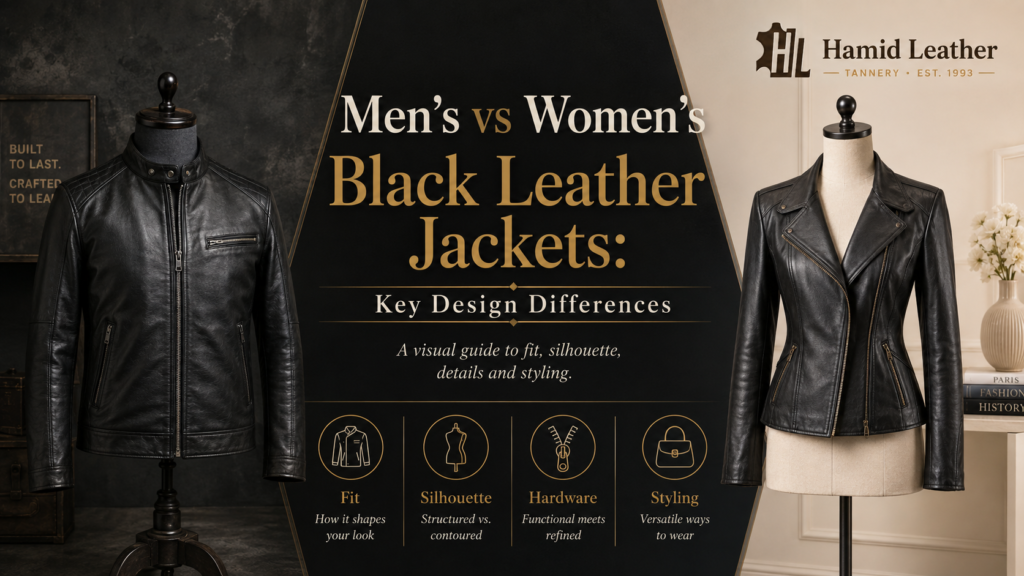
Black leather jackets are worn by men and women across almost every major fashion market. Their appeal comes from their durability, versatility and ability to add structure and confidence to an outfit. Although many styles appear similar at first, men’s and women’s black leather jackets often differ considerably in their patterns, proportions, fit and detailing.
The main differences are not simply based on size. A women’s leather jacket is not necessarily a smaller version of a men’s jacket. Manufacturers usually adjust the shoulder width, chest shaping, waist, hips, sleeve proportions and overall length to suit the intended customer.
However, modern fashion is making these categories more flexible. Oversized jackets, unisex collections, gender-neutral sizing and relaxed silhouettes allow customers to choose designs according to their preferred appearance instead of following traditional labels.
This guide explains the key design differences between men’s and women’s black leather jackets. It covers fit, measurements, popular styles, leather selection, construction, styling and important considerations for fashion brands and wholesale buyers.
What Is a Men’s Black Leather Jacket?
A men’s black leather jacket is normally developed using a pattern based on typical male body proportions. It usually provides greater width through the shoulders and chest, a straighter body shape and more room in the upper arms.
Common characteristics include:
- Broad shoulder construction
- Straight or slightly tapered body shape
- Longer sleeves
- Greater chest width
- Lower or less pronounced waist shaping
- Larger pockets
- Substantial hardware
- Longer body length
- Structured collars and lapels
- Heavier leather in some classic styles
These features vary according to the jacket’s category. A men’s café racer may have a slim and minimal shape, while a bomber may be fuller through the body. A biker jacket can be closely fitted, whereas an oversized streetwear jacket may use deliberately dropped shoulders.
The term “men’s jacket” describes the intended pattern and size system rather than a rule about who can wear it. Women may choose a men’s jacket when they want a straighter, longer or more oversized silhouette.
What Is a Women’s Black Leather Jacket?
A women’s black leather jacket is generally designed around typical female body proportions. It may have narrower shoulders, additional room through the bust, a more defined waist and greater accommodation around the hips.
Common characteristics include:
- Narrower shoulder width
- Shaping around the bust
- A more defined waist
- Shorter body and sleeve proportions
- Curved side seams
- Higher armholes
- Smaller or differently positioned pockets
- Lighter hardware
- Cropped or hip-length options
- Greater variation in silhouette
Women’s leather jackets are available in many styles, including biker jackets, bombers, blazers, cropped jackets, aviators, oversized designs and leather overshirts.
Not every women’s jacket is closely fitted. Modern collections frequently include boxy, oversized and unisex-inspired silhouettes. The key difference is that these shapes are usually developed intentionally rather than created by simply increasing a standard size.
The Main Difference Between Men’s and Women’s Leather Jackets
The most important difference is the pattern.
A garment pattern determines the jacket’s shape before the leather is cut. It controls the shoulders, chest, waist, hips, armholes, sleeves, collar, pockets and overall length.
Men’s jackets normally begin with broader shoulders and a straighter torso. Women’s patterns frequently require more shaping between the bust, waist and hips.
This affects how the jacket hangs when worn. A men’s jacket placed on a female body may fit correctly at the shoulders but feel narrow around the hips. Alternatively, choosing a larger size to accommodate the hips may make the shoulders and sleeves excessively large.
Similarly, a women’s jacket worn by a man may feel restrictive across the shoulders, chest or upper arms even when the waist measurement appears suitable.
These differences are general rather than universal. Individual body shapes vary widely, which is why exact garment measurements are more useful than gender labels alone.
Men’s vs Women’s Black Leather Jackets: Quick Comparison
| Feature | Men’s black leather jacket | Women’s black leather jacket |
|---|---|---|
| Shoulders | Usually broader and more structured | Generally narrower or softly shaped |
| Chest | Wider with less shaping | Often shaped to accommodate the bust |
| Waist | Straight or slightly tapered | Frequently more defined |
| Hips | Limited additional width | May include extra room or curved shaping |
| Body length | Usually longer | Often shorter, cropped or hip length |
| Sleeves | Generally longer and wider | Usually shorter and more tapered |
| Armholes | Often lower and wider | Frequently higher and more shaped |
| Pockets | Larger and placed lower | Often smaller and placed to suit the waist |
| Hardware | Commonly larger or heavier | May be lighter, smaller or decorative |
| Fit options | Regular, slim, relaxed and oversized | Fitted, cropped, boxy, relaxed and oversized |
| Common styles | Biker, bomber, café racer and aviator | Biker, cropped, blazer, bomber and oversized |
| Overall shape | Straighter and broader | More curved or deliberately shaped |
Differences in Shoulder Construction
Shoulder width is one of the clearest differences between many men’s and women’s leather jackets.
Men’s patterns usually provide more width across the back and shoulders. This allows the jacket to fit a broader upper body and creates the structured appearance commonly associated with men’s outerwear.
Women’s jackets often have narrower shoulders. The shoulder seam may sit closer to the natural shoulder point, while the sleeve head can be shaped to create a cleaner line.
Shoulder construction affects comfort as well as appearance. If the jacket is too narrow, the wearer may feel pulling across the upper back when reaching forward. The sleeves may also rise excessively when the arms move.
If the shoulders are too wide, the seams may fall down the upper arms. This can be intentional in an oversized jacket, but it may look poorly fitted in a classic biker or café racer design.
Leather does soften with use, but the shoulder structure will not completely change. Buyers should therefore prioritise the shoulder fit when choosing a fitted jacket.
Differences in Chest and Bust Shaping
Men’s jackets usually have a relatively straight chest construction. The pattern provides space across the chest without creating pronounced curves.
Women’s jackets may require additional shaping for the bust. This can be achieved through:
- Curved front panels
- Princess seams
- Side-panel shaping
- Carefully positioned darts
- Adjusted armholes
- Contoured front zips
- Greater front-body length
Bust shaping must be subtle and balanced. Excessive shaping can restrict the jacket’s styling versatility, while insufficient room may cause the front zip to pull or create horizontal creases.
A jacket that fits the waist but is too small at the bust may not close comfortably. Going up a size can provide more room, but it may also make the shoulders, sleeves and waist too loose.
For online purchases, the buyer should compare the jacket’s chest measurement with a similar garment that already fits well. Body measurements and finished garment measurements are not the same because the jacket requires wearing ease.
Differences in Waist Shaping
Traditional men’s leather jackets generally have a straight or slightly tapered waist. Motorcycle-inspired café racers may fit closely, but their shape normally remains less curved than that of a fitted women’s jacket.
Women’s jackets often use curved side seams or shaped panels to create greater definition at the waist. This is especially common in fitted biker jackets and leather blazers.
Waist shaping affects the position of several other components, including:
- Pocket openings
- Waist belts
- Side seams
- Front zips
- Decorative panels
- Hem width
A fitted waist can create a polished silhouette, but it must still allow comfortable movement and layering. A winter jacket may require enough space for a jumper, while a lightweight fashion jacket may be designed for a thin shirt or top.
Modern women’s jackets do not always define the waist. Boxy bombers and oversized biker jackets may deliberately create a straighter silhouette.
Differences Around the Hips
Hip construction becomes especially important when a jacket finishes below the natural waist.
Men’s leather jackets are frequently cut relatively straight through the lower body. If a woman wears a longer men’s jacket, it may fit at the chest but feel tight when closed over the hips.
Women’s jackets that extend to the hip may include:
- A wider hem
- Curved side seams
- Side vents
- Two-way front zips
- Adjustable side tabs
- Stretch or ribbed sections
A two-way zip can improve comfort when sitting because the lower section can be opened without unfastening the entire jacket.
Cropped jackets avoid some hip-fitting issues because they finish at or above the waist. However, the shorter length changes the balance of the entire pattern and requires careful pocket and zip placement.
Differences in Jacket Length
Men’s leather jackets are commonly longer in both the body and sleeves. Many finish around the waist or upper hip, depending on the design.
Women’s leather jackets have greater length variation. They may be:
- Cropped above the waist
- Waist length
- High-hip length
- Full-hip length
- Longline or coat length
Cropped jackets are especially popular in women’s fashion because they coordinate well with high-waisted trousers, jeans and skirts. They can define the waist and create a balanced silhouette.
A classic men’s biker or café racer jacket usually finishes near the belt line. This position provides coverage while remaining comfortable in a seated position.
Length should be evaluated according to use rather than gender alone. A short jacket offers movement and strong proportions but provides less warmth. A longer design provides more coverage but may feel restrictive if the lower body is too narrow.
Differences in Sleeve Design
Men’s leather jacket sleeves are generally longer and provide more space through the upper arms and forearms.
Women’s sleeves are often:
- Slightly shorter
- Narrower through the upper arm
- More tapered toward the wrist
- Shaped at the elbow
- Paired with higher armholes
The ideal sleeve should finish around the wrist bone or slightly below it. Motorcycle-inspired jackets may use longer sleeves because the arms extend forward while riding.
Sleeve length should be checked while the arms are relaxed and while they are bent. A sleeve that appears correct when standing may rise too far when reaching forward.
Zipped cuffs can make sleeves easier to put on and allow adjustment around gloves or thicker layers. Ribbed cuffs, commonly found on bomber jackets, hold the sleeve closer to the wrist.
For wholesale production, brands should approve sleeve length across several sizes. Simply grading every component by the same amount can produce inaccurate proportions at the smallest and largest ends of the range.
Differences in Armholes and Mobility
Armhole design significantly affects comfort.
Men’s jackets may use slightly lower and wider armholes to accommodate larger shoulders and upper arms. Traditional bombers often have relaxed armholes, while slim café racers use a closer shape.
Women’s fitted jackets may use higher armholes to create a cleaner silhouette. A well-designed high armhole can improve movement, but one that is too small may cause pressure under the arms.
The wearer should test the jacket by:
- Reaching forward
- Raising both arms
- Bending the elbows
- Crossing the arms
- Sitting down
- Closing the front zip
Severe pulling across the back or chest indicates a fit problem. Leather may become softer, but it should not be expected to correct an unsuitable armhole shape.
Differences in Pocket Size and Placement
Pockets are often larger on men’s leather jackets. They may be positioned lower and designed to hold a phone, wallet, keys or gloves.
Women’s jackets sometimes use smaller pockets to preserve a fitted shape. Pocket openings may be placed at an angle to follow the waist or side-panel construction.
However, excessively small or decorative pockets can reduce practicality. Modern customers often expect enough internal storage for a smartphone and other essentials.
Pocket placement also affects appearance. Large patch pockets can add volume, while concealed welt pockets maintain a clean surface.
Brands should test pockets with real objects during sampling. A pocket may look attractive in a technical drawing but prove too shallow or narrow during use.
Differences in Collars and Lapels
Men’s jackets frequently use substantial collars, narrow band collars or broad biker lapels. These details support the structured appearance of classic motorcycle and aviation styles.
Women’s designs may include:
- Smaller lapels
- Wider fashion lapels
- Collarless necklines
- Funnel collars
- Detachable shearling collars
- Draped or asymmetric collars
- Minimal band collars
Collar shape can significantly change the jacket’s identity. A narrow band collar creates a clean café-racer appearance, while wide lapels make a biker jacket look more dramatic.
A collar should sit smoothly without creating excessive pressure around the neck. Large lapels must be secured properly so they do not fold unpredictably.
For colder jackets, shearling or faux-fur collars provide warmth and visual character. Their size should remain balanced with the wearer’s shoulders and the overall jacket length.
Differences in Hardware
Men’s black leather jackets often use substantial metal zips, snaps and buckles. Silver, gunmetal and antique finishes are common in classic biker and aviator designs.
Women’s jackets may use smaller or lighter hardware, although heavily detailed biker jackets are also popular. Fashion-focused designs may include:
- Polished metal zips
- Matte-black fastenings
- Decorative pulls
- Waist belts
- Studs
- Chains
- Branded snaps
- Two-way zips
Hardware should be selected according to the leather weight. A heavy zip may distort lightweight lambskin, while a weak zip can feel unsuitable on thick cowhide.
All hardware should be tested during sampling. The main zip must operate smoothly without catching the lining, while snaps should close securely without requiring excessive force.
Differences in Leather Selection
Both men’s and women’s jackets can use cowhide, goatskin, sheepskin, lambskin, buffalo leather or synthetic alternatives. However, the desired silhouette often influences material selection.
Cowhide
Cowhide is durable and naturally suited to structured biker, café racer and bomber jackets. It is frequently used in men’s heritage styles, but it also works well for women’s biker jackets.
Heavy cowhide creates a strong silhouette but may require a breaking-in period. Thinner cowhide can provide greater comfort while maintaining useful durability.
Goatskin
Goatskin provides a good balance between strength, flexibility and moderate weight. Its natural grain works well for men’s and women’s bombers, flight jackets and casual designs.
It can maintain structure without feeling as heavy as some cowhide jackets.
Lambskin
Lambskin is soft, lightweight and smooth. It is widely used for fitted women’s jackets, cropped styles, leather blazers and luxury fashion garments.
It is also suitable for modern men’s jackets, particularly minimalist and slim-fit designs. However, it is generally more delicate than substantial cowhide.
Sheepskin and Shearling
Sheepskin can be used for lightweight fashion jackets, while shearling retains the wool for insulation.
Men’s aviator jackets may use heavier, more rugged shearling. Women’s versions may use a shorter body, shaped waist or lighter construction.
The differences between heritage-inspired and contemporary designs are explored further in this guide to classic vs modern black leather jackets.
Buffalo Leather
Buffalo leather has a prominent grain and rugged character. It is often selected for men’s vintage-inspired jackets, although it can also create distinctive women’s biker and oversized styles.
Faux Leather
Faux leather provides an animal-free and generally more affordable alternative. It can be used for both men’s and women’s fashion jackets.
Quality varies considerably. Low-quality synthetic material may peel or crack around sleeves, cuffs and folds. Brands should evaluate durability instead of judging the material only by its appearance.
Popular Men’s Black Leather Jacket Styles
Men’s Biker Jacket
The men’s biker jacket commonly features an asymmetrical front zip, broad lapels, zipped cuffs, several pockets and an adjustable belt.
Its design creates a strong, structured appearance. Traditional versions use thick cowhide, while fashion-focused alternatives may use softer goatskin or lambskin.
Men’s Café Racer Jacket
A café racer has a central zip, streamlined body and narrow band collar. It usually contains less hardware than a double-rider biker jacket.
Its clean design makes it suitable for casual and smart-casual clothing.
Men’s Bomber Jacket
A leather bomber normally uses a central zip, ribbed cuffs, fitted waistband and rounded body shape. It can be made from cowhide, goatskin or sheepskin.
Modern bombers may have oversized proportions, dropped shoulders or minimal external pockets.
Men’s Aviator Jacket
The men’s aviator jacket is associated with military flight clothing. It may include a shearling collar, warm lining, ribbed edges and practical pockets.
It is especially suitable for winter collections and heritage-focused brands.
Men’s Leather Blazer
A leather blazer combines traditional tailoring with the texture of leather. It generally features a notched collar, button closure and longer body.
Soft lambskin or lightweight goatskin works well because the material must drape more naturally than heavy motorcycle leather.
Popular Women’s Black Leather Jacket Styles
Women’s Fitted Biker Jacket
A fitted women’s biker jacket retains classic lapels and asymmetrical hardware while adding bust and waist shaping.
It can be styled with jeans, dresses, skirts and tailored trousers.
Women’s Cropped Leather Jacket
A cropped jacket finishes near or above the natural waist. It may use biker, bomber or minimalist details.
Correct proportion is essential because shortening an ordinary jacket without adjusting its pockets and zip can make the design look unbalanced.
Women’s Leather Blazer
A leather blazer provides a refined alternative to the traditional biker jacket. It may have a single-breasted or double-breasted closure and can be worn with dresses, trousers or denim.
Women’s Oversized Jacket
An oversized women’s jacket uses dropped shoulders, wide sleeves and a relaxed body. It can be inspired by men’s outerwear but should still be developed as a balanced oversized pattern.
Women’s Bomber Jacket
A women’s bomber may be fitted, cropped, boxy or oversized. Ribbed cuffs and waistbands maintain the style’s recognisable identity.
Women’s Aviator Jacket
A women’s aviator jacket may use a shorter body, defined waist or oversized shearling collar. Modern versions range from fitted winter jackets to relaxed streetwear designs.
Are Men’s Jackets Always Heavier?
Men’s leather jackets are sometimes heavier because they use more material, larger hardware and thicker hides. Classic biker and motorcycle-inspired jackets may be particularly substantial.
However, gender does not determine weight by itself. A lightweight men’s lambskin jacket may weigh less than an oversized women’s shearling jacket.
Weight depends on:
- Leather thickness
- Jacket size
- Body length
- Lining
- Insulation
- Hardware
- Number of panels
- Pocket construction
- Additional trims
A heavier jacket is not automatically better. The material should suit the climate, intended use and target customer.
Are Women’s Jackets Always More Fitted?
No. Although shaped and cropped jackets are common in women’s fashion, many women’s designs are relaxed, boxy or oversized.
A women’s oversized jacket may still differ from a men’s jacket. Its sleeve length, pocket position, hem width and overall balance can be adjusted for the intended size range.
Similarly, men’s jackets are not always loose. Slim café racers and minimalist jackets can fit closely through the chest, waist and sleeves.
The relevant question is not whether the jacket is labelled for men or women, but whether its measurements and silhouette match the wearer’s preferred fit.
Can Women Wear Men’s Black Leather Jackets?
Yes. Women frequently wear men’s leather jackets to achieve an oversized, straight or relaxed appearance.
Before choosing one, check:
- Shoulder width
- Sleeve length
- Chest measurement
- Hem width
- Body length
- Pocket position
- Jacket weight
If the jacket is selected several sizes larger, the sleeves may become excessively long and the pockets may sit too low. A deliberately oversized or unisex pattern often provides a more balanced result.
Women who have broad shoulders or prefer minimal waist shaping may also find certain men’s styles comfortable without creating an extremely oversized appearance.
Can Men Wear Women’s Black Leather Jackets?
A man can wear any jacket that fits comfortably and provides the desired appearance. However, some women’s patterns may feel narrow across the shoulders, chest and upper arms.
Fitted women’s jackets may also contain pronounced waist and bust shaping. Cropped lengths and smaller hardware can create a more fashion-forward silhouette.
Exact measurements should guide the decision. If the shoulders, chest, sleeves and armholes fit correctly, the gender category does not prevent the garment from being worn successfully.
Understanding Unisex Leather Jackets
Unisex leather jackets are designed to serve a broader range of customers through neutral proportions and flexible styling.
Common unisex features include:
- Relaxed or oversized fit
- Dropped shoulders
- Straight body shape
- Simple closures
- Adjustable hems or cuffs
- Minimal shaping
- Broad size range
- Gender-neutral colour and detailing
Developing a good unisex jacket requires more than applying a new label to an existing men’s pattern. The brand must consider how the garment will fit different shoulder, chest, waist and hip proportions.
A single fit may not work equally well for everyone. Brands should provide detailed garment measurements and show the jacket on models with different body types.
How Men’s and Women’s Leather Jackets Should Fit
A properly fitting leather jacket should feel secure without preventing natural movement.
Shoulder Fit
The shoulder seams should normally sit close to the wearer’s natural shoulder points unless the jacket is intentionally oversized.
Chest and Bust Fit
The jacket should close without strong pulling, distorted zips or severe horizontal creases.
Waist and Hem Fit
The lower section should sit comfortably without riding upward. Longer jackets must provide enough room around the hips.
Sleeve Fit
The sleeves should reach the wrists and allow the elbows to bend comfortably.
Movement
The wearer should be able to reach forward, sit down and raise the arms without excessive pressure.
Leather may soften over time, but it should not be expected to correct seriously incorrect measurements.
How to Choose the Correct Size Online
Size labels are not consistent between brands. A medium from one manufacturer may differ significantly from another.
Check the finished garment measurements for:
- Chest
- Shoulder width
- Sleeve length
- Body length
- Waist
- Hem
- Upper-arm width
Compare these measurements with a jacket that already fits well. Lay the existing jacket flat and measure it using the same method described by the seller.
Also consider what will be worn underneath. A winter jacket may need room for knitwear, while a lightweight jacket may only require space for a shirt or T-shirt.
Review the return and exchange policy before ordering. Leather jackets are structured garments, so small measurement differences can noticeably affect comfort.
Styling Men’s Black Leather Jackets
For a timeless casual outfit, combine a café racer or biker jacket with a plain T-shirt, straight jeans and boots.
A minimalist leather jacket can be worn over a fine-knit jumper with tailored trousers and Chelsea boots for a smart-casual appearance.
For streetwear, choose an oversized bomber or biker jacket and pair it with a hoodie, relaxed trousers and trainers.
A shearling aviator works well with dark denim, knitwear and sturdy boots during colder weather.
Avoid combining too many heavily themed pieces unless that is the intended look. A biker jacket, chains, distressed trousers and large boots can make the outfit appear costume-like.
Styling Women’s Black Leather Jackets
A fitted biker jacket can be worn with high-waisted jeans, a simple top and ankle boots.
For contrast, layer a structured leather jacket over a midi dress. The leather adds definition while the softer fabric creates balance.
A cropped jacket works well with wide-leg trousers, skirts and high-rise denim because it highlights the waist.
An oversized leather jacket can be styled with leggings, knitwear and trainers or combined with loose trousers for a streetwear silhouette.
A leather blazer can be paired with tailored trousers, a blouse and loafers for a more polished appearance.
When the jacket has large lapels, heavy hardware or a prominent shearling collar, keep other accessories relatively simple.
How to Check Jacket Quality
Quality standards should remain consistent across men’s and women’s jackets.
Inspect the Leather
The leather should feel appropriate for the style. Cowhide may be firm and structured, while lambskin should feel soft and smooth.
Natural variation is normal, but neighbouring panels should not have severely mismatched colour, grain or shine.
Examine the Stitching
Look for straight and consistent stitching around the shoulders, armholes, pockets, collar and front closure.
Loose threads, skipped stitches and uneven seam lines may indicate weak quality control.
Test the Zips
Open and close every zip several times. It should move smoothly without separating or catching the lining.
Check the Lining
The lining should sit smoothly inside the jacket without twisting, sagging or extending below the leather shell.
Review the Hardware
Snaps, buckles and decorative components should be securely attached and free from sharp edges.
Test the Pockets
Check whether the pockets are functional and deep enough for their intended purpose.
Assess Movement
Close the jacket and move naturally. Tightness around the shoulders, chest, bust or armholes should not be severe.
Common Buying Mistakes
One common mistake is choosing a jacket based only on its gender label. Exact garment measurements provide more useful information.
Another is selecting a size that is too tight and expecting the leather to stretch significantly. The material may soften, but the shoulders and chest will not necessarily expand enough.
Some buyers choose a men’s jacket for an oversized look by purchasing several sizes larger. This can create excessively long sleeves and incorrectly positioned pockets.
Others focus only on the outer leather while ignoring the lining, stitching and hardware. These components can fail before the leather shell.
Buying a heavy jacket for a warm climate is another mistake. Thick cowhide and shearling may be durable, but they can become uncomfortable if the jacket is intended for mild weather.
Finally, an ordinary fashion leather jacket should not automatically be treated as protective motorcycle clothing. Specialist riding jackets require suitable abrasion resistance, construction and protective components.
Custom Manufacturing for Fashion Brands
For fashion brands, wholesalers and retailers, the differences between men’s and women’s jackets must be addressed during product development.
The process normally begins with a sketch, reference sample or technical pack. The buyer and manufacturer should confirm:
- Target customer
- Intended fit
- Leather type
- Leather thickness
- Surface finish
- Chest or bust shaping
- Shoulder width
- Waist and hip measurements
- Body and sleeve length
- Pocket size and position
- Hardware
- Lining
- Labels
- Packaging
- Size range
- Production tolerances
Separate base patterns are normally required for fitted men’s and women’s jackets. Simply reducing a men’s pattern may not provide correct bust, waist or hip proportions.
A physical sample should be produced before bulk manufacturing. The jacket must be assessed on a suitable fit model, and movement should be tested as carefully as appearance.
For custom development and bulk production, Hamid Leather Ltd manufactures leather garments for international fashion brands, wholesalers and retailers.
Developing Men’s and Women’s Size Ranges
A well-developed size range requires professional grading. Grading increases or decreases the pattern between sizes while maintaining the design’s intended proportions.
Not every measurement should change by the same amount. Shoulders, chest, waist, hips, sleeve width and body length may require different grade rules.
Brands should consider regional sizing differences. A size developed for one market may not match customer expectations in another.
The size chart should clearly state whether the listed figures are body measurements or finished garment measurements. Confusing these two systems can cause returns and customer dissatisfaction.
If a brand offers unisex jackets, it should provide enough information for customers to understand how the garment fits different body types.
Production Considerations
Leather is a natural material, so production requires different handling from ordinary woven fabric.
Manufacturers must consider:
- Natural marks and grain
- Panel-to-panel colour consistency
- Leather thickness
- Stretch direction
- Seam construction
- Hardware weight
- Reinforcement
- Needle and thread selection
- Pattern placement
- Waste reduction
Women’s fitted jackets may use more panels to create bust and waist shaping. This increases the importance of accurate cutting and panel matching.
Men’s structured jackets may use heavier leather, stronger interlining and larger hardware. The construction must support this weight without making the garment unnecessarily stiff.
For both categories, stress points around pockets, armholes and zips should be reinforced properly.
Sustainability and Responsible Manufacturing
Sustainability should be evaluated through measurable practices rather than broad marketing claims.
A durable jacket that remains wearable for many years may reduce the need for frequent replacement. Longevity depends on material quality, strong construction, repairability and a design that remains relevant.
Manufacturers can improve responsible production through:
- Controlled chemical use
- Effective wastewater management
- Energy efficiency
- Workplace safety
- Careful material sourcing
- Efficient pattern placement
- Responsible waste handling
- Product quality control
Leather offcuts can sometimes be used for small accessories, labels or reinforcement pieces.
Brands should request evidence for environmental and social claims. Certifications, audit information and documented production practices are more reliable than vague terms such as “green” or “eco-friendly.”
Caring for Men’s and Women’s Leather Jackets
Care depends on the leather type rather than the jacket’s gender category.
Hang the jacket on a wide, supportive hanger to protect the shoulders. Avoid thin wire hangers.
Store it in a cool, dry and ventilated place away from prolonged sunlight. Direct light can cause black leather to fade.
Do not keep the jacket permanently sealed in plastic. Use a breathable garment cover if protection is needed.
Remove dust with a soft cloth. For stains, use a cleaner intended for the specific leather type and test it on a hidden section first.
Condition smooth leather when it begins to feel dry. Use conditioner sparingly because excessive application may darken the material or leave a greasy finish.
If the jacket becomes wet, blot away moisture and allow it to dry naturally at room temperature. Keep it away from radiators, heaters and hair dryers.
Suede, nubuck and shearling require specialised care. Do not apply ordinary smooth-leather cream to these materials.
Repair damaged zips, torn linings and loose seams early to prevent the problem from becoming more serious.
Frequently Asked Questions
What is the main difference between men’s and women’s leather jackets?
The main difference is the pattern. Men’s jackets usually have broader shoulders, a straighter torso and longer sleeves, while women’s jackets may include bust, waist and hip shaping.
Are women’s leather jackets just smaller men’s jackets?
No. Properly designed women’s jackets use different proportions rather than simply reducing every measurement.
Can women wear men’s leather jackets?
Yes. Men’s jackets can create a relaxed or oversized look. Shoulder width, sleeve length and hem measurements should still be checked.
Can men wear women’s leather jackets?
Yes, provided the measurements and silhouette are suitable. Some women’s styles may be narrower across the shoulders and upper arms.
Why are women’s jacket pockets sometimes smaller?
Smaller pockets may be used to preserve a fitted silhouette, although functional pockets are generally more practical.
Are men’s leather jackets more durable?
Not necessarily. Durability depends on the leather, stitching, hardware and construction rather than whether the jacket is designed for men or women.
Which leather is best for a men’s jacket?
Cowhide is suitable for rugged biker jackets, goatskin balances strength and flexibility, and lambskin works well for lightweight luxury designs.
Which leather is best for a women’s jacket?
Lambskin is popular for soft fitted jackets, while cowhide suits structured biker styles. The best choice depends on the desired design and use.
Should a leather jacket fit tightly?
It should feel secure without restricting movement. The front should close comfortably, and the arms should move naturally.
Are oversized jackets unisex?
Some are, but not every oversized jacket uses a unisex pattern. Customers should check exact measurements.
How should a cropped leather jacket fit?
It should sit securely around the waist without rising excessively. The shoulders, bust and sleeves must still fit comfortably.
Why do men’s jackets usually have longer sleeves?
Men’s patterns are generally developed for longer average arm measurements. Some motorcycle-inspired jackets also use additional sleeve length for riding positions.
Can a tailor alter a leather jacket?
Some alterations are possible, including sleeve shortening and waist adjustment. However, leather alterations require specialist equipment and experience.
Are black leather jackets suitable for every season?
Lightweight, uninsulated jackets can work in spring and autumn. Heavy cowhide and shearling are better suited to colder weather.
How long can a genuine leather jacket last?
A well-made leather jacket can last for many years or even decades with suitable use, storage and maintenance.
Is a unisex leather jacket better for a fashion brand?
It can broaden the potential customer base, but the pattern and sizing must be carefully developed. Detailed measurements are essential.
Final Thoughts
The key differences between men’s and women’s black leather jackets are found in their patterns, proportions and intended fit.
Men’s jackets generally provide broader shoulders, a straighter torso, longer sleeves and more room through the upper body. Women’s jackets frequently include bust shaping, a defined waist, additional hip accommodation and shorter or more varied body lengths.
These characteristics are not strict rules. Men’s designs can be slim and lightweight, while women’s jackets can be straight, boxy or oversized. Unisex fashion has also made traditional categories more flexible.
The best jacket is the one that provides the desired silhouette while fitting comfortably through the shoulders, chest or bust, waist, hips and sleeves. Gender labels can provide a useful starting point, but exact garment measurements are more reliable.
Material selection also influences the result. Cowhide creates structure and durability, goatskin offers strength with flexibility, and lambskin provides a softer, lighter appearance. The leather should always match the jacket’s intended use and design.
Before buying, inspect the leather, stitching, lining, zips, hardware and pockets. Test the jacket while moving, sitting and reaching forward. Do not depend on the expectation that leather will stretch enough to correct an unsuitable fit.
For fashion brands and wholesale buyers, separate pattern development, careful sampling and accurate grading are essential. A successful collection should consider the body proportions, climate, styling preferences and practical expectations of its target market.
Whether the customer chooses a structured men’s café racer, a fitted women’s biker jacket or an oversized unisex design, a thoughtfully developed black leather jacket can provide long-term versatility, comfort and distinctive style.