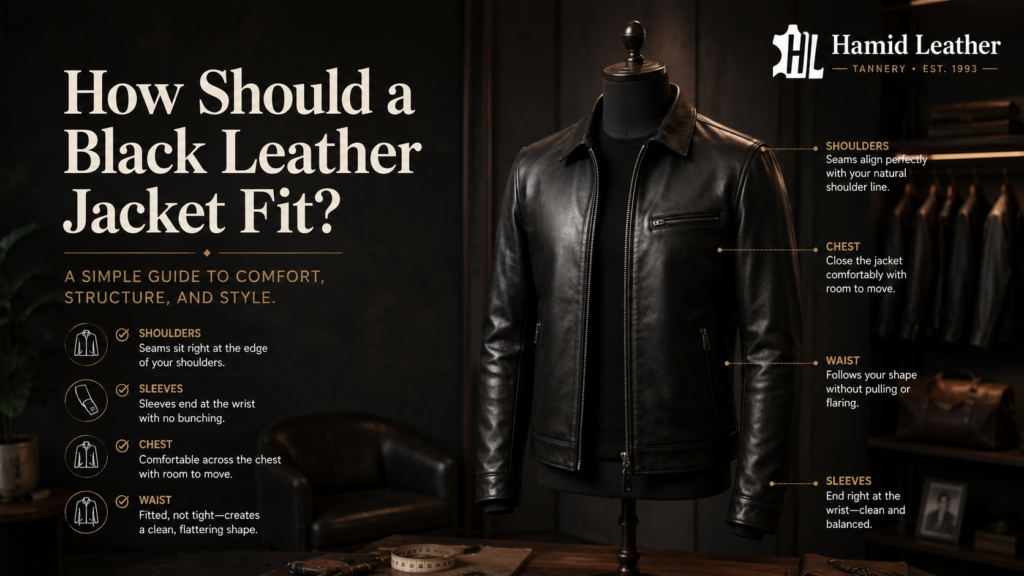
A black leather jacket should fit close enough to create a clean, structured silhouette while still allowing comfortable movement. It should not feel painfully tight, restrict your arms or place excessive pressure on the zip and seams.
The correct fit depends on the jacket style, leather type, body shape and clothing you plan to wear underneath it. A slim lambskin café racer will fit differently from a relaxed leather bomber or a thick cowhide biker jacket.
This guide explains how a black leather jacket should fit across the shoulders, chest, sleeves, waist and body. It also covers sizing, layering, movement and online shopping considerations for individual and B2B buyers.
Why the Fit of a Leather Jacket Matters
Fit affects more than appearance. It also influences comfort, movement, durability and how the jacket ages.
A correctly fitted black leather jacket should:
- Follow the body’s natural shape
- Allow normal arm movement
- Close without excessive strain
- Provide suitable room for layering
- Maintain balanced proportions
- Avoid unnecessary bulk
- Place minimal stress on the seams
- Feel secure without causing discomfort
A jacket that is too tight may strain the stitching, zip and leather around the shoulders, chest and underarms. A jacket that is too large may look shapeless, create excess material around the back and cause the sleeves or shoulders to hang incorrectly.
Decide What You Will Wear Underneath
Before choosing a size, decide how you expect to wear the jacket.
If you normally wear it over a T-shirt or lightweight shirt, a closer fit may be appropriate. If you plan to wear jumpers, hoodies or thermal layers, the jacket will need additional space through the chest, shoulders, sleeves and armholes.
Common layering options include:
- T-shirt
- Polo shirt
- Formal shirt
- Lightweight knitwear
- Sweatshirt
- Hoodie
- Thick winter jumper
- Thermal clothing
Try the jacket with the type of layer you intend to wear regularly. A jacket that fits perfectly over a T-shirt may become uncomfortable when worn over thick knitwear.
Understand the Intended Jacket Style
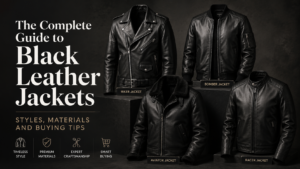
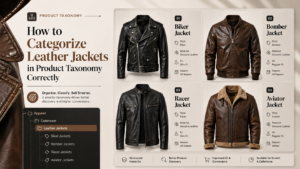
Different black leather jacket styles are designed to fit differently.
Biker Jacket
A biker jacket normally has a close, structured fit. The shoulders should sit securely, while the chest should allow the asymmetric zip to close without pulling.
Because biker jackets often use substantial cowhide, belts and heavy hardware, some initial firmness is normal. However, the jacket should still permit natural movement.
Café Racer Jacket
A café racer usually has a slim or regular silhouette with a straight front zip and band collar.
It should follow the chest and waist without creating excessive folds. The clean design makes shoulder alignment and sleeve length particularly important.
Bomber Jacket
A leather bomber generally has a more relaxed body. Ribbed cuffs and waistbands create shape at the sleeves and hem.
The chest may have more space than a café racer, but the jacket should not look excessively wide or inflated.
Aviator Jacket
Aviator jackets are often heavier and roomier because they may include shearling, quilted lining or insulation.
They should allow space for warm clothing without making the shoulders look oversized. The weight should remain balanced across the body.
Leather Blazer
A black leather blazer should have a tailored appearance. The shoulder line should be clean, the lapels should lie flat and the front should close without pulling.
Soft lambskin, sheepskin or calfskin can provide the drape required for this style.
Oversized Leather Jacket
An oversized jacket intentionally uses dropped shoulders, a wider body and longer sleeves. It should still look balanced rather than appearing as though the wearer accidentally selected the wrong size.
How Should the Shoulders Fit?
The shoulders are one of the most important areas to examine.
For a standard or slim-fitting jacket, the shoulder seams should generally align with your natural shoulder points. They should not sit significantly above the shoulders or extend too far down the arms.
Signs of a correct shoulder fit include:
- Shoulder seams align with the body
- The jacket lies smoothly across the upper back
- There is no severe pulling around the armholes
- The collar remains in the correct position
- The sleeves hang naturally
- You can raise and extend your arms
The shoulders may be too tight if:
- The seams sit above your natural shoulders
- The leather pulls strongly across the back
- The collar moves backwards
- The armholes press painfully
- You cannot reach forward comfortably
- The front zip becomes distorted
The shoulders may be too large if:
- The seams fall significantly down the upper arms
- Excess leather gathers around the shoulder area
- The sleeves appear too long
- The jacket loses its intended shape
Dropped shoulder seams can be correct on intentionally relaxed or oversized designs. Always consider the intended silhouette before judging the fit.
How Should the Chest Fit?
The chest should feel secure when the jacket is fully closed, but it should not be compressed.
Close the main zip or buttons and check whether:
- The front lies reasonably flat
- The zip remains straight
- You can breathe normally
- You can move your arms
- There is no severe pulling around the chest
- The lapels or collar remain correctly positioned
- The seams are not under excessive pressure
Some small tension lines may appear on a fitted jacket, especially when new leather is firm. However, deep horizontal pulling lines usually indicate that the chest is too tight.
If the front panels overlap excessively, the leather collapses around the chest or large folds appear near the armholes, the jacket may be too large.
How Should the Waist Fit?
The correct waist fit depends on the jacket’s cut.
A slim café racer or fitted biker jacket may follow the waist closely. A bomber may have a wider body that is shaped by a ribbed waistband, while a straight-cut jacket may provide more room around the midsection.
The waist should:
- Follow the intended silhouette
- Allow the jacket to close comfortably
- Avoid excessive pressure when sitting
- Sit smoothly without large folds
- Provide enough room for planned layers
A tight waistband can cause the jacket to rise when you move or sit. It may also place unnecessary pressure on the front zip.
For people with a fuller midsection, a straight or regular fit may be more comfortable than a jacket with a sharply tapered waist.
How Long Should the Sleeves Be?
For most black leather jackets, the sleeves should end around the wrist bone or slightly below it when your arms are resting naturally.
Biker and motorcycle-inspired jackets may use slightly longer sleeves because the arms extend forward during riding. Fashion jackets and leather blazers generally require a cleaner wrist-length finish.
Check the sleeve length while:
- Standing naturally
- Bending your elbows
- Reaching forward
- Raising your arms
- Holding a steering wheel position
The sleeves may be too short if they expose a large part of the wrist during ordinary movement. They may be too long if they cover most of the hands, bunch heavily at the cuffs or interfere with daily activities.
Remember that sleeve length can appear shorter when the shoulders are too narrow. Check both areas before deciding that the sleeves require alteration.
How Should the Upper Arms Fit?
The upper sleeves should follow the arms without pressing tightly against them.
You should be able to:
- Bend your elbows
- Raise your arms
- Reach forward
- Wear the intended layer
- Move without severe pulling
Athletic or muscular wearers may require additional room through the biceps and shoulders. Choosing a larger standard size may create enough arm space but make the waist and body excessively wide.
In such cases, a jacket with an athletic cut or custom measurements may provide a better result.
How Should the Armholes Fit?
Armhole height strongly affects comfort and movement.
Higher armholes can create a cleaner, more tailored silhouette and allow the arms to move without lifting the entire jacket. However, they should not cut into the underarms.
Extremely low armholes may:
- Create excess material
- Reduce mobility
- Make the jacket lift when the arms move
- Produce a loose or bulky appearance
The armholes should feel secure while still allowing natural movement. If they cause pain, numbness or severe pressure, the jacket is too restrictive.
How Long Should the Body Be?
The correct body length depends on the jacket style and the wearer’s proportions.
Typical lengths include:
- Biker jacket: waist or upper hip
- Café racer: waist or upper hip
- Bomber jacket: around the waist
- Aviator jacket: waist to hip
- Leather blazer: below the hip
- Long leather jacket: upper thigh or lower
A short jacket can make the legs appear longer and create a sharper silhouette. A longer jacket provides greater coverage and may suit taller wearers.
When checking the body length, make sure the jacket does not rise excessively when you raise your arms or sit down.
How Should the Collar Fit?
The collar should sit evenly without twisting, lifting or creating excessive pressure around the neck.
For a café racer jacket, the band collar should close comfortably. You should be able to turn your head without feeling restricted.
For a biker jacket, the lapels should lie evenly when open, and the snaps should align correctly. On a leather blazer, the collar and lapels should sit flat against the chest.
A collar that pulls backwards may indicate tight shoulders or an inaccurate pattern.
How Should the Back Fit?
The back should look smooth when you stand naturally, but it must contain enough room for movement.
Small folds around the shoulder blades and armholes can be normal because the jacket needs movement allowance.
Warning signs include:
- Strong horizontal pulling lines
- Severe tension across the shoulder blades
- Large vertical folds
- Excess leather around the lower back
- A hem that rises significantly
- A jacket that twists to one side
Reach forward with both arms. The back may feel slightly firm, particularly in a new cowhide jacket, but it should not prevent the movement.
Perform a Complete Movement Test
Do not judge the jacket only while standing still in front of a mirror.
Once the jacket is closed:
- Raise both arms
- Reach forward
- Bend your elbows
- Cross your arms
- Turn your upper body
- Sit down
- Place your hands in the pockets
- Move your head from side to side
- Try it with your intended layers
The jacket should remain comfortable and balanced throughout these movements.
Some resistance is normal with thick, new leather. However, the jacket should not cause pain, restrict breathing or place extreme pressure on the seams and zip.
Should a Leather Jacket Fit Tightly at First?
A new leather jacket may feel firmer than it will after regular wear, particularly when it is made from thick cowhide or buffalo leather.
Natural leather can soften and adapt slightly around areas of movement, such as the elbows, shoulders and waist. However, buyers should not depend on dramatic stretching.
A jacket should not be purchased several sizes too small with the expectation that it will eventually fit.
Normal initial firmness may include:
- Slight resistance when bending the elbows
- A structured feeling around the shoulders
- Firm leather around the waist
- Limited but comfortable tension when reaching forward
Unacceptable tightness includes:
- Pain
- Restricted breathing
- Numbness
- Inability to close the jacket
- Severe pulling around seams
- A distorted front zip
- Restricted basic arm movement
Slim Fit vs Regular Fit vs Relaxed Fit
Slim Fit
A slim-fit jacket follows the body closely and creates a modern silhouette.
It is most suitable for:
- Lightweight layers
- Fashion-focused styling
- Lean or athletic builds
- Soft and flexible leather
It provides less space for winter clothing.
Regular Fit
A regular fit balances comfort and shape. It generally provides moderate room through the chest, waist and arms.
It is suitable for:
- Everyday wear
- Light layering
- Different body shapes
- Long-term versatility
Relaxed Fit
A relaxed fit provides additional room throughout the body and sleeves.
It is useful for:
- Layering
- Casual styling
- Greater freedom of movement
- Contemporary oversized outfits
A relaxed jacket should still maintain appropriate shoulder, sleeve and body proportions.
Consider Your Body Shape
The most suitable fit depends partly on your proportions.
Athletic Build
People with broad shoulders and a narrower waist may find standard jackets tight across the upper body but loose around the waist. An athletic cut or custom sizing may provide a better fit.
Lean Build
A slim café racer or biker jacket can add structure to a lean frame. Avoid excessive body width unless an oversized look is intended.
Fuller Midsection
A straight-cut or regular-fit jacket may provide greater comfort. Avoid excessively tight ribbed waistbands or sharply tapered designs.
Shorter Height
Waist-length jackets can maintain balanced proportions. Excessively long sleeves and bodies may make the jacket appear oversized.
Taller Height
Tall sizing or custom measurements may be necessary to achieve suitable sleeve and body length without making the jacket too wide.
These are general guidelines. Comfort and personal preference remain more important than rigid styling rules.
How to Measure Yourself for a Leather Jacket
Use a flexible measuring tape and keep it level without pulling it excessively tight.
Important body measurements include:
- Chest circumference
- Natural waist circumference
- Hip circumference
- Shoulder width
- Sleeve length
- Upper-arm circumference
- Back length
- Neck circumference
For the chest, measure around the fullest part while keeping your arms relaxed.
For the sleeve, measure from the shoulder point to the wrist. Some manufacturers measure from the centre back of the neck, so follow the specific size guide carefully.
Wear the type of clothing you expect to use underneath the jacket while taking measurements.
Compare Garment and Body Measurements
Body measurements describe your physical size, while garment measurements describe the dimensions of the finished jacket.
A jacket must be larger than the body to provide comfort and movement. This additional space is called ease.
The amount of ease depends on:
- Jacket style
- Leather thickness
- Intended fit
- Lining
- Layering
- Body shape
- Design details
Always confirm whether a seller’s size chart shows body or garment measurements. Confusing the two can result in choosing the wrong size.
Use a Well-Fitting Jacket as a Reference
When shopping online, compare the product measurements with a similar jacket that already fits you well.
Lay your existing jacket flat and measure:
- Chest from armpit to armpit
- Shoulder seam to shoulder seam
- Sleeve from shoulder to cuff
- Body from the back collar seam to hem
- Waist width
- Hem width
- Upper-arm width
Follow the same measurement method used by the seller.
For more online sizing, quality and seller-evaluation advice, read this guide on what to look for when buying a black leather jacket online.
Common Signs That a Leather Jacket Is Too Small
A jacket may be too small if:
- The zip cannot close comfortably
- The front panels pull apart
- Strong horizontal lines appear across the chest
- The shoulders feel painful
- The collar moves backwards
- The armholes press into the body
- You cannot reach forward
- The sleeves rise excessively
- The seams appear strained
- The jacket restricts breathing
- The hem rises significantly during movement
A close-fitting leather jacket can still be comfortable. Tightness becomes a problem when it restricts movement or places excessive pressure on the garment.
Common Signs That a Leather Jacket Is Too Large
A jacket may be too large if:
- The shoulder seams extend unintentionally down the arms
- The sleeves cover most of the hands
- Excess leather gathers around the chest
- Large folds appear across the back
- The body looks shapeless
- The collar does not sit correctly
- The jacket shifts excessively during movement
- The waist or hem is much wider than intended
- The armholes hang too low
These signs may be intentional in an oversized design. Compare the fit with the product’s intended silhouette.
Can a Leather Jacket Be Altered?
Some leather-jacket alterations are possible, but they require specialist skills.
Common alterations may include:
- Shortening sleeves
- Adjusting sleeve width
- Reducing the waist
- Shortening the body
- Replacing zips
- Adjusting cuffs
Major shoulder, armhole or chest alterations can be difficult and expensive because they may require reconstructing several parts of the jacket.
Leather retains needle holes, so incorrect alterations can leave permanent marks. It is usually better to select the correct shoulder and chest fit from the beginning.
Fit Advice for Men’s and Women’s Jackets
Men’s leather jackets generally provide more width through the shoulders and use a straighter body shape.
Women’s jackets may include:
- A more defined waist
- Additional shaping through the bust
- Narrower shoulders
- Different hip measurements
- Shorter sleeve or body proportions
However, modern leather jackets are available in many unisex, oversized and gender-neutral styles.
Buyers should focus on actual garment measurements and intended fit rather than relying only on gender labels.
Advice for B2B Buyers
Fashion brands, wholesalers and retailers must evaluate fit carefully before approving bulk production.
B2B buyers should provide or approve:
- Complete measurement charts
- Grading rules
- Measurement tolerances
- Fit model measurements
- Intended layering
- Leather thickness
- Lining construction
- Shrinkage allowances
- Sleeve angle
- Armhole shape
- Shoulder slope
- Sample size
- Size range
A fitting session should assess both appearance and movement. The sample should be tested while standing, sitting, reaching and bending the arms.
Leather thickness can affect the final fit. A pattern developed using soft lambskin may feel different when produced in thick cowhide, even if the measurements remain identical.
Before bulk manufacturing, buyers should approve a complete pre-production sample in the correct leather, lining and hardware.
For custom leather-jacket development and bulk production, Hamid Leather Ltd works with international fashion brands, wholesalers and retailers.
Common Fit Mistakes to Avoid
When selecting a black leather jacket, avoid:
- Buying only according to S, M or L labels
- Ignoring the shoulder fit
- Expecting the leather to stretch dramatically
- Forgetting to account for layering
- Selecting a larger size only for longer sleeves
- Judging the fit while standing still
- Ignoring upper-arm measurements
- Choosing an extremely tight chest
- Confusing garment and body measurements
- Assuming all brands use identical sizing
- Removing tags before completing a movement test
- Approving B2B production without a fitting sample
Frequently Asked Questions
How tight should a black leather jacket be?
It should sit close to the body without restricting breathing or natural movement. The zip should close comfortably, and the seams should not appear excessively strained.
Where should the shoulder seams sit?
For standard and slim fits, they should generally align with your natural shoulder points. Oversized jackets may intentionally use dropped shoulders.
Where should leather-jacket sleeves end?
Most sleeves should end around the wrist bone or slightly below it. Motorcycle-inspired jackets may use longer sleeves.
Should I size up in a leather jacket?
Only if the measurements show that you need additional room, particularly for layering. Do not size up automatically because it may make the shoulders and sleeves too large.
Should a leather jacket feel stiff when new?
Thick cowhide and buffalo leather may feel firm initially. The jacket should still allow essential movement and should not cause pain.
Will a leather jacket stretch?
Natural leather may soften and adapt slightly in areas of movement, but it will not reliably stretch several sizes.
Should I be able to zip my leather jacket?
Yes. Even if you often wear it open, the jacket should close without excessive strain.
How should a biker jacket fit?
A biker jacket should have a close, structured fit with secure shoulders and enough chest and arm space for movement.
How should a leather bomber jacket fit?
A bomber should usually provide more room through the body while the waistband and cuffs create shape.
How should a café racer fit?
A café racer should have a streamlined silhouette, clean shoulder alignment and limited excess material around the chest and waist.
How much room should there be for layering?
There should be enough space for your intended layer without distorting the zip, shoulders or sleeves. Test the jacket with that layer before choosing the size.
What is the most important fit area?
The shoulders are particularly important because major shoulder alterations are difficult. The chest, armholes and upper arms must also allow comfortable movement.
Can leather-jacket sleeves be shortened?
Yes, but the work should be completed by a specialist familiar with leather garments, especially when the cuffs include zips or snaps.
What should muscular buyers check?
They should check the shoulder, chest, bicep and armhole measurements carefully. An athletic cut or custom sizing may fit better than simply choosing a larger standard size.
How can I choose the correct size online?
Compare the exact garment measurements with a similar jacket you already own and review the seller’s measurement method.
What should B2B buyers approve before production?
They should approve the measurement chart, tolerances, grading, fit sample, leather thickness, lining and pre-production sample.
Final Thoughts
A black leather jacket should follow the body’s shape without restricting comfort or movement.
Begin with the shoulders. For most standard designs, the seams should align with your natural shoulder points, and the jacket should sit smoothly across the upper back. The chest should close securely without severe pulling, while the armholes and upper sleeves should permit natural movement.
Sleeves should generally finish around the wrist, although biker and riding-inspired styles may be slightly longer. The correct body length depends on the design: biker, café racer and bomber jackets often finish near the waist or upper hip, while leather blazers extend lower.
Always consider what you will wear underneath the jacket. A close fit may work over a T-shirt, but additional space is necessary for jumpers, hoodies or winter layers.
Do not rely only on standard size labels. Compare exact garment measurements with a jacket you already own, and perform a complete movement test before deciding whether the fit is correct.
A good leather jacket may soften slightly with wear, but it should not depend on dramatic stretching to become comfortable. The correct size should feel secure from the beginning without causing pain, restricting breathing or placing excessive stress on the seams.
For B2B buyers, fit must be confirmed through complete samples, documented measurements and physical fitting sessions. The pattern, leather thickness, lining and intended layering should all be evaluated before bulk production.
Ultimately, the best-fitting black leather jacket is one that balances silhouette, comfort and movement. When the shoulders, chest, sleeves, waist and body length work together correctly, the jacket will look better, feel more comfortable and perform reliably over time.