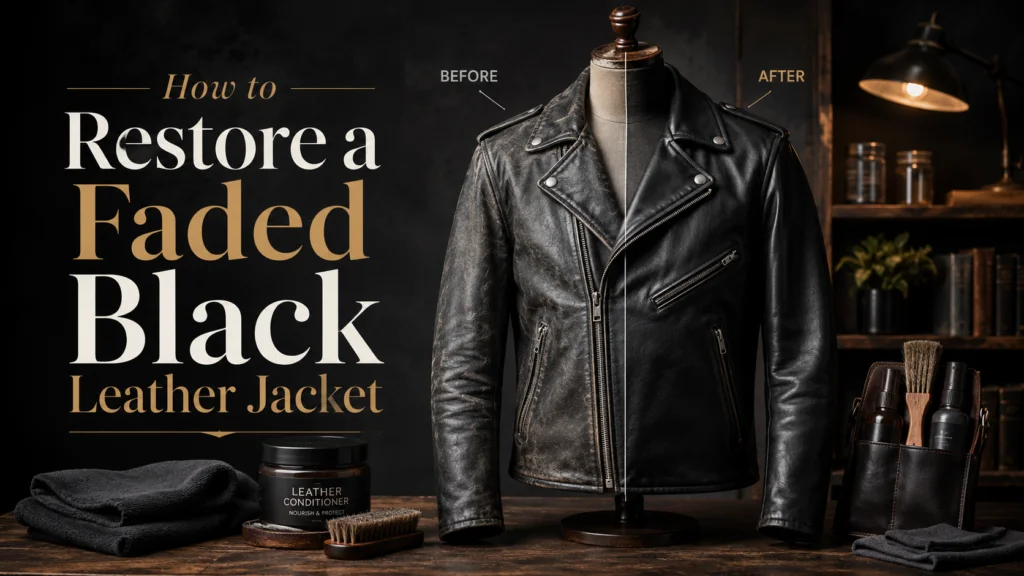
A black leather jacket can look exceptional for years, but regular wear, sunlight, dryness, moisture and improper care can gradually reduce the depth of its colour. What was once a rich black finish may begin to look grey, dull, patchy or slightly brown around the shoulders, sleeves, collar and other exposed areas.
Fortunately, fading does not always mean that a leather jacket needs to be replaced.
Learning how to restore a faded black leather jacket can help revive its appearance, restore flexibility and extend its usable life. Depending on the severity of the fading, restoration may involve nothing more than cleaning and conditioning or, in more advanced cases, using a specialist black leather recolouring product.
However, leather restoration should be approached carefully.
Leather is a natural material, and different leather types, dyes and surface finishes react differently to cleaning agents, conditioners and colour-restoration products. An aggressive treatment that works on one jacket could permanently change another.
This guide explains how to assess faded black leather, clean and condition it, restore lost colour, protect the finish and prevent future fading.
Why Does Black Leather Fade?
Black leather does not normally lose its colour overnight.
Fading is usually gradual and occurs because of repeated exposure to environmental conditions.
The most common causes include:
- Sunlight
- UV radiation
- Dryness
- Heat
- Friction
- Rain and moisture
- Improper cleaning
- Harsh chemicals
- Age
- Poor-quality finishing
- Incorrect storage
Understanding the cause helps determine the best restoration method.
Sunlight and UV Exposure
Ultraviolet radiation is one of the biggest causes of fading in black leather.
When a jacket is repeatedly exposed to strong sunlight, UV rays can gradually break down the pigments in the leather’s surface finish.
You may notice fading first around:
- Shoulders
- Upper sleeves
- Back
- Collar
- Chest
These are the areas most exposed when the jacket is worn outdoors.
A jacket can also fade while it is not being worn.
Leaving black leather:
- Beside a sunny window
- Inside a hot car
- On an exposed clothing rack
can create uneven colour changes.
Natural Ageing
Leather naturally changes as it ages.
High-quality genuine leather often develops character, texture and subtle colour variation over time.
This process is sometimes referred to as patina.
A small amount of natural ageing is not necessarily damage.
In fact, many leather enthusiasts appreciate the appearance of well-worn leather.
However, when the colour becomes extremely uneven or the leather begins looking dry and grey, restoration may improve its appearance.
Dry Leather Can Look Faded
Sometimes what appears to be colour loss is actually dryness.
Leather contains oils that contribute to its:
- Flexibility
- Texture
- Colour depth
- Surface appearance
When these oils decrease, black leather can look dull.
Applying an appropriate conditioner may significantly improve the colour without requiring any dye.
This is why you should always clean and condition the jacket before deciding that full recolouring is necessary.
Friction and Everyday Wear
Certain areas experience more contact than others.
For example:
- Elbows
- Cuffs
- Pocket edges
- Collar
- Waistband
- Shoulders
Repeated friction can gradually wear away surface pigment.
Bags can also create fading around shoulder areas.
Over time, frequently touched sections may become noticeably lighter than the rest of the jacket.
Incorrect Cleaning Products
Using harsh cleaning agents can strip away leather finishes and pigments.
Avoid using:
- Bleach
- Strong detergents
- Alcohol
- Household disinfectants
- Glass cleaner
- Furniture cleaner
- Abrasive cleaners
These products are not designed for leather garments.
Even one aggressive cleaning session may create uneven fading.
Can a Faded Black Leather Jacket Be Restored?
In many cases, yes.
The restoration method depends on the condition of the leather.
There are generally three levels of fading.
Light Fading
The jacket looks slightly dull, but the black colour remains relatively even.
Usually, cleaning and conditioning may be enough.
Moderate Fading
Some areas appear grey or significantly lighter.
A specialist black leather recolouring cream or balm may be required.
Severe Fading
Large sections have lost significant colour, or the finish has completely worn away.
Professional recolouring may be the safest option.
First Determine Whether the Leather Is Actually Faded
Before applying dye or recolouring products, inspect the jacket carefully.
Sometimes dirt, dust or dryness can make black leather appear faded.
Place the jacket under natural indoor lighting.
Compare areas such as:
- Inside collar
- Under pocket flaps
- Under sleeves
- Inside belt areas
These sections often receive less sunlight and wear.
If they appear significantly darker than exposed areas, true fading has probably occurred.
Identify the Type of Leather
Before restoring colour, identify the leather type.
Traditional black leather restoration products are primarily designed for smooth finished leather.
Different materials require different care.
Smooth Finished Leather
This is commonly used for:
- Biker jackets
- Bomber jackets
- Racer jackets
- Motorcycle jackets
It can usually accept appropriate conditioning and recolouring products.
Lambskin
Lambskin is soft and delicate.
Aggressive rubbing or heavy dye can change its texture.
Professional treatment may be safer for expensive lambskin jackets.
Sheepskin
Sheepskin can also be relatively soft.
Use lightweight products and test carefully.
Suede
Do not use ordinary smooth-leather colour cream on suede.
Suede requires specialist sprays and restoration products.
Nubuck
Nubuck also requires dedicated care.
Standard leather balm can flatten its distinctive surface texture.
How to Restore a Faded Black Leather Jacket Step by Step
Restoration should be performed gradually.
Never begin by immediately applying black dye over the entire jacket.
Follow this process.
Step 1: Read the Care Label
Start by reading the manufacturer’s care instructions.
Some jackets may specify:
- Professional leather cleaning only
- No solvents
- No washing
- No home treatment
If the garment contains a special finish, following the care label becomes particularly important.
Step 2: Inspect the Leather
Look closely for:
- Cracks
- Scratches
- Peeling
- Dryness
- Water damage
- Mould
- Colour loss
- Loose stitching
Colour restoration will not repair serious structural damage.
If the leather is deeply cracked or peeling, professional repair may be required first.
Step 3: Remove Dust
Use a clean microfiber cloth.
Gently wipe the entire jacket to remove:
- Dust
- Loose dirt
- Hair
- Surface particles
Do not rub aggressively.
Particles trapped beneath recolouring products can create uneven results.
Step 4: Clean the Jacket
Before restoring colour, the leather must be clean.
Use a specialist leather cleaner designed for clothing.
Apply a small quantity to a soft cloth rather than pouring it directly onto the jacket.
Work in small sections.
Pay attention to:
- Collar
- Cuffs
- Pocket edges
- Front panels
Avoid soaking the material.
Once cleaned, allow the jacket to dry naturally.
Always Perform a Patch Test
Never apply a new product across the entire garment without testing it first.
Choose a hidden area such as:
- Inside the hem
- Under the collar
- Inside a cuff
- Behind a pocket flap
Apply a small amount.
Wait according to the product instructions.
Check for:
- Discolouration
- Excessive darkening
- Stickiness
- Texture changes
- Loss of shine
If the result looks normal, continue.
Step 5: Condition the Leather
After cleaning, evaluate whether the jacket is dry.
If it feels:
- Stiff
- Rough
- Dull
apply a suitable leather conditioner.
Use only a thin layer.
Work the conditioner gently into the leather using a soft microfiber cloth.
Allow it to absorb fully.
You may discover that the conditioner alone restores much of the black appearance.
This happens because conditioned leather often reflects light differently and looks richer.
Do Not Over-Condition
A common mistake is assuming that heavily faded leather requires a large amount of conditioner.
This can make the surface:
- Greasy
- Sticky
- Excessively soft
- Uneven
Conditioner restores oils.
It does not replace missing pigment.
If the leather remains visibly faded after conditioning, you may need a recolouring product.
Step 6: Choose a Black Leather Recolouring Product
For moderate fading, look for a specialist product designed for smooth leather garments.
Common options include:
- Black leather recolouring balm
- Pigmented leather cream
- Leather colour restorer
- Specialist leather dye
Creams and balms are generally easier for home users than permanent dyes.
They can refresh colour without requiring a complete refinishing process.
Always check whether the product is suitable for clothing rather than only:
- Shoes
- Furniture
- Car seats
- Saddles
Recolouring Balm vs Leather Dye
These products serve different purposes.
Recolouring Balm
A balm usually adds pigment to worn surface areas.
It is useful for:
- Light fading
- Scuffs
- Uneven colour
- Moderate wear
It is relatively easy to apply.
Leather Dye
Dye penetrates more deeply.
It may be appropriate for:
- Severe fading
- Full restoration
- Major colour loss
However, dye is more difficult to use.
Incorrect application can create:
- Streaks
- Uneven colour
- Permanent stains
- Texture changes
Professional help may be preferable for expensive garments.
Step 7: Apply the Colour in Thin Layers
When using an approved recolouring product, thin applications usually produce better results.
Place a small amount onto:
- Microfiber cloth
- Sponge applicator
- Product-recommended applicator
Apply gently using circular motions.
Work on one area at a time.
For example:
- Front panel
- Second front panel
- Sleeves
- Shoulders
- Back
- Collar
Do not flood the leather with pigment.
Match the Colour Carefully
Black may sound like a simple colour, but different jackets can have different finishes.
Some may appear:
- Jet black
- Matte black
- Charcoal black
- Warm black
- Glossy black
A recolouring product can sometimes make one area appear darker than another.
Patch testing is therefore essential.
Step 8: Build Colour Gradually
If one coat does not fully restore the leather, do not immediately apply a thick second layer.
Allow the first layer to dry according to the product instructions.
Then evaluate the colour.
Apply additional thin layers only where necessary.
Gradual colouring creates a more natural and even finish.
Step 9: Blend the Edges
When restoring only faded sections, blend the treatment slightly beyond the affected area.
Sharp boundaries can create visible colour differences.
Work gradually from the faded section into surrounding leather.
This helps achieve a more consistent result.
Step 10: Allow the Jacket to Dry Naturally
After applying colour, hang the jacket on a broad hanger.
Place it in a:
- Dry
- Ventilated
- Shaded
room.
Do not accelerate drying with:
- Hair dryer
- Heater
- Radiator
- Direct sunlight
Heat can cause leather to become dry or alter the finish.
Step 11: Buff the Surface
Once the product has completely dried, gently buff the leather using a clean cloth.
This can remove excess pigment and create a more even appearance.
If the cloth continues picking up large amounts of black pigment, allow the jacket more drying time.
Step 12: Apply Protection if Recommended
Some leather colour-restoration systems include a protective finish.
This can help reduce:
- Colour transfer
- Moisture penetration
- Future fading
- Surface wear
Use only products compatible with the recolouring system.
Mixing unrelated products can create undesirable reactions.
How to Restore a Black Leather Jacket Without Dye
If the fading is mild, you may be able to improve the jacket without recolouring.
Try:
- Cleaning
- Conditioning
- Gentle buffing
- Applying a leather protector
This approach is particularly suitable when the jacket is simply dull rather than severely faded.
How to Restore Dry and Faded Leather
Dryness and fading often occur together.
Start with moisture restoration.
Use a high-quality leather conditioner in a thin layer.
Allow it to absorb before evaluating the colour.
If the leather remains grey or patchy after conditioning, use an appropriate recolouring product.
Do not attempt to fix dryness by applying excessive dye.
Colour restoration works best when the leather itself remains healthy.
How to Restore Faded Leather Sleeves
Sleeves often fade because they receive significant sunlight and friction.
Pay particular attention to:
- Elbows
- Upper arms
- Cuffs
When applying recolouring cream:
- Start around the most faded area.
- Apply a small amount.
- Blend outward.
- Compare the sleeve against the body.
- Repeat gradually if necessary.
Treat both sleeves consistently so that they do not appear different.
How to Restore Faded Shoulders
Shoulders commonly receive the highest UV exposure.
They may also be affected by:
- Backpack straps
- Bags
- Seat belts
Recolour gradually.
Avoid applying heavy pigment directly along seam lines.
Blend the product into the surrounding leather to create a natural transition.
How to Restore Faded Cuffs
Cuffs experience constant movement and contact.
Before recolouring them:
- Remove body oils and dirt
- Check for cracks
- Condition if dry
Apply colour carefully because heavily worn cuffs can absorb more product than less worn leather.
How to Restore a Faded Leather Collar
Collars are particularly vulnerable to:
- Skin oils
- Sweat
- Hair products
- Friction
- Perfume
Clean the collar thoroughly before applying recolouring cream.
Do not apply excessive product because residue may later transfer to clothing.
Can Shoe Polish Restore a Black Leather Jacket?
Using standard shoe polish across a leather jacket is generally not recommended.
Shoe polish may contain:
- Heavy waxes
- Strong pigments
- Solvents
It is formulated primarily for footwear.
It may create an unnaturally glossy finish or transfer colour onto:
- Shirts
- Car seats
- Furniture
Use products specifically intended for leather garments whenever possible.
Can You Use Black Shoe Dye on a Leather Jacket?
Technically, some leather dyes are used across different leather products, but shoe-specific products may not be suitable for garment leather.
Jackets require:
- Flexibility
- Softness
- Low colour transfer
A dye that works on rigid footwear may produce poor results on thin lambskin or fashion leather.
Choose a product specifically approved for garments.
Avoid Household Oils
You may find online suggestions recommending:
- Olive oil
- Coconut oil
- Vegetable oil
- Baby oil
These are not ideal leather-restoration products.
They may initially darken faded leather, creating the appearance of restoration.
However, they can:
- Oxidise
- Create stains
- Attract dust
- Become sticky
- Darken leather unevenly
Use professional leather-care products instead.
Can Petroleum Jelly Restore Faded Leather?
Petroleum jelly may temporarily darken some leather, but it is not a proper colour-restoration treatment.
It can leave greasy residue and alter the surface finish.
A dedicated leather conditioner or recolouring balm is a safer choice.
Do Not Use Permanent Markers
Another risky home remedy is using a black marker on faded areas.
This can create:
- Blue or purple tones
- Uneven patches
- Permanent stains
- Colour transfer
Markers are not leather dyes.
Use products specifically formulated for leather.
How to Restore Vintage Black Leather Jackets
Vintage jackets require extra care.
Older leather may already have:
- Reduced moisture
- Weak stitching
- Dry fibres
- Cracking
- Previous repairs
Aggressive recolouring can worsen damage.
Before treating vintage leather:
- Inspect its structural condition.
- Test any cleaner.
- Condition cautiously.
- Use colour restoration only if necessary.
For valuable vintage garments, professional restoration is often safer.
When Should You Use Professional Leather Restoration?
Home restoration is suitable for many lightly or moderately faded jackets.
However, professional help is recommended when:
- The leather is badly cracked
- Large areas have lost all pigment
- The finish is peeling
- The jacket is expensive
- The jacket is vintage
- Lambskin is severely faded
- Colour loss is highly uneven
- Previous home treatments have failed
Professionals may use specialised:
- Cleaners
- Pigments
- Dyes
- Sealers
- Airbrush systems
This can create a more consistent finish than manual home application.
Can Faded Black Leather Be Made Completely New Again?
Sometimes dramatic improvement is possible, but restoration does not always make old leather identical to factory-new leather.
Natural ageing may remain visible.
Small:
- Creases
- Scratches
- Texture variations
- Patina
are normal.
The goal should be to improve:
- Colour consistency
- Moisture
- Flexibility
- Appearance
rather than erase every sign of use.
How to Protect a Restored Black Leather Jacket
Once you restore the colour, prevention becomes important.
Good aftercare can help the result last longer.
Limit Direct Sunlight
You do not need to avoid wearing the jacket outside.
However, avoid leaving it unnecessarily in strong sunlight.
Never store it:
- Beside windows
- Inside hot cars
- Outside on balconies
Use a Leather Protector
A suitable protector can provide resistance against:
- Light rain
- Dirt
- Surface stains
Some products also offer UV protection.
Always check compatibility with the leather finish.
Condition Periodically
Conditioning helps maintain leather flexibility.
For many jackets, once or twice per year may be sufficient.
Do not over-condition.
Store the Jacket Properly
Correct storage can prevent renewed fading and dryness.
Hang the jacket on:
- A broad wooden hanger
- A padded hanger
Store it:
- In a cool room
- Away from sunlight
- In a breathable garment bag
Avoid plastic covers for long-term storage.
Keep Leather Away from Heat
Do not store your jacket near:
- Radiators
- Boilers
- Fireplaces
- Heating vents
Heat accelerates moisture loss.
Dry leather can quickly begin looking faded again.
Clean Stains Quickly
Do not allow dirt and oils to remain on leather for months.
However, aggressive cleaning should also be avoided.
Use gentle leather-specific products when needed.
How Leather Quality Influences Colour Retention
Not all black leather jackets fade at the same rate.
Colour durability can depend on:
- Leather quality
- Tanning
- Dye penetration
- Pigmentation
- Surface finish
- Manufacturing
- Aftercare
Premium leather that has been properly tanned and finished generally offers better consistency and ageing characteristics.
For B2B buyers, retailers and fashion brands, sourcing from an experienced manufacturer is therefore important.
Businesses looking for leather garment production can explore Hamid Leather Ltd, a Pakistan-based B2B leather manufacturer serving international buyers.
Why Tanning Matters
Tanning stabilises raw hide and transforms it into usable leather.
Different tanning processes influence:
- Texture
- Flexibility
- Colour
- Durability
Colour is often introduced through dyeing and finishing stages.
If these processes are poorly controlled, black leather may develop:
- Uneven colour
- Weak adhesion
- Premature fading
Quality control during manufacturing is therefore important.
Pigmented vs Aniline Leather
Understanding leather finish can also help explain fading.
Pigmented Leather
Pigmented leather receives a surface colour coating.
It usually offers:
- Uniform colour
- Better stain resistance
- Improved UV resistance
However, the surface pigment may wear away in high-friction areas.
Aniline Leather
Aniline leather is dyed with transparent dyes and has little or no heavy surface pigment.
It preserves more natural grain.
However, it can be more sensitive to:
- Sunlight
- Moisture
- Stains
Restoration requires greater care.
Semi-Aniline Leather
Semi-aniline leather combines dyeing with a light protective coating.
It provides a balance between:
- Natural appearance
- Colour protection
- Durability
Knowing which finish your jacket has can help you choose appropriate products.
Common Mistakes When Restoring Faded Black Leather
Avoid these common errors.
Applying Dye Before Cleaning
Dirt prevents colour from bonding evenly.
Always clean first.
Using Too Much Product
Heavy layers can create:
- Streaks
- Greasiness
- Uneven shine
Thin coats are better.
Skipping the Patch Test
This is one of the biggest mistakes.
Always test an inconspicuous area.
Using Heat to Dry the Jacket
Heat can damage both leather and new colour treatments.
Air drying is safer.
Mixing Multiple Products
Using cleaner, conditioner, dye and protector from unrelated systems without checking compatibility can cause unexpected reactions.
Expecting One Thick Coat to Work
Professional-looking restoration usually requires patience.
Several thin layers produce better results than one heavy application.
Ignoring Cracked Leather
Colour alone cannot repair structural damage.
Treat dryness and cracking before cosmetic restoration.
Leather Restoration for Retailers and Fashion Brands
Colour consistency is especially important in B2B leather garments.
Retailers should inspect stock for:
- Uneven fading
- Colour transfer
- Surface scratches
- Storage damage
Leather jackets should be protected from sunlight in:
- Warehouses
- Showrooms
- Store windows
Display pieces may fade faster than boxed inventory because they receive constant light exposure.
Rotating displays can help reduce prolonged UV exposure to one garment.
How to Prevent Fading in Retail Displays
Retailers can reduce fading by:
- Limiting strong sunlight
- Using UV-filtering windows where appropriate
- Rotating products
- Avoiding high-heat lights
- Maintaining proper humidity
Premium black leather requires thoughtful handling even before it reaches the final customer.
How Long Does Restored Leather Colour Last?
The lifespan of a restored finish depends on:
- Quality of the restoration product
- Leather condition
- Frequency of wear
- Sun exposure
- Friction
- Cleaning
- Maintenance
A well-restored jacket that receives proper care may maintain its improved appearance for a considerable period.
However, areas such as cuffs and elbows may need occasional touch-ups because they receive constant friction.
Can You Change a Faded Brownish Black Jacket Back to Deep Black?
In many cases, yes.
If UV exposure has turned the leather slightly brown or grey, a black leather recolouring product may restore deeper colour.
The final result depends on how much surface finish remains.
Severely damaged leather may require professional refinishing.
Why Does Black Leather Turn Grey?
Grey-looking leather is often caused by:
- Dryness
- UV fading
- Surface wear
- Dust accumulation
Begin by cleaning and conditioning.
If the grey appearance remains, pigment loss is more likely.
How to Maintain Black Colour After Restoration
A simple maintenance routine can help.
After Wear
Hang the jacket and allow it to air.
Monthly
Inspect frequently used areas.
Every Few Months
Remove dust with a soft cloth.
Once or Twice per Year
Condition if necessary.
During Storage
Use a breathable garment bag and keep the jacket away from sunlight.
Frequently Asked Questions
Can you restore a faded black leather jacket?
Yes. Light fading can often be improved through cleaning and conditioning, while moderate fading may require a specialist black leather recolouring product.
What is the best product for faded black leather?
Use a leather recolouring balm, pigmented cream or dye specifically formulated for the type of leather you are treating.
Can conditioner restore faded leather?
Conditioner may improve dull or dry leather, but it cannot fully replace pigment that has worn away.
How do I make black leather look black again?
Clean the leather, condition it if necessary and apply a suitable black recolouring product in thin, even layers.
Can I use black shoe polish?
Shoe polish is generally not recommended for leather jackets because it may transfer colour or alter the garment’s finish.
Can sunlight fade a black leather jacket?
Yes. UV exposure is a major cause of leather colour fading.
Should I dye the whole jacket?
Not necessarily. Mild fading can often be treated locally. Severe or widespread fading may require full professional recolouring.
Can faded lambskin be restored?
Yes, but lambskin is delicate. Professional restoration may be safer for expensive garments.
How can I stop leather from fading again?
Limit prolonged sunlight, store the jacket properly, condition when necessary and use an appropriate leather protector.
Can deep cracks be fixed with recolouring cream?
No. Recolouring products improve appearance but do not repair deeply damaged leather fibres.
Final Thoughts
Learning how to restore a faded black leather jacket can help transform a dull, grey or uneven garment into something that looks considerably richer and better maintained.
The key is to begin with the least aggressive treatment.
Start by inspecting and cleaning the leather.
If the material is dry, apply an appropriate conditioner.
In many cases, restoring moisture alone can significantly deepen the appearance of black leather.
If genuine colour loss remains, use a specialist black leather recolouring balm or cream designed for the specific type of leather. Apply it gradually in thin layers and always test the product first.
Severely faded, cracked, vintage or valuable jackets may benefit from professional leather restoration.
Once the colour has been restored, correct maintenance becomes essential.
Protect the jacket from excessive sunlight, heat and moisture. Store it on a broad hanger inside a cool, ventilated wardrobe and condition it only when necessary.
A quality black leather jacket is designed to age, and small signs of wear can contribute to its character. Proper restoration is not about making leather look artificial or completely untouched. It is about preserving its colour, flexibility, durability and premium appearance for as long as possible.
With the right combination of quality manufacturing, responsible care and thoughtful restoration, a black leather jacket can continue looking stylish and distinctive for many years.