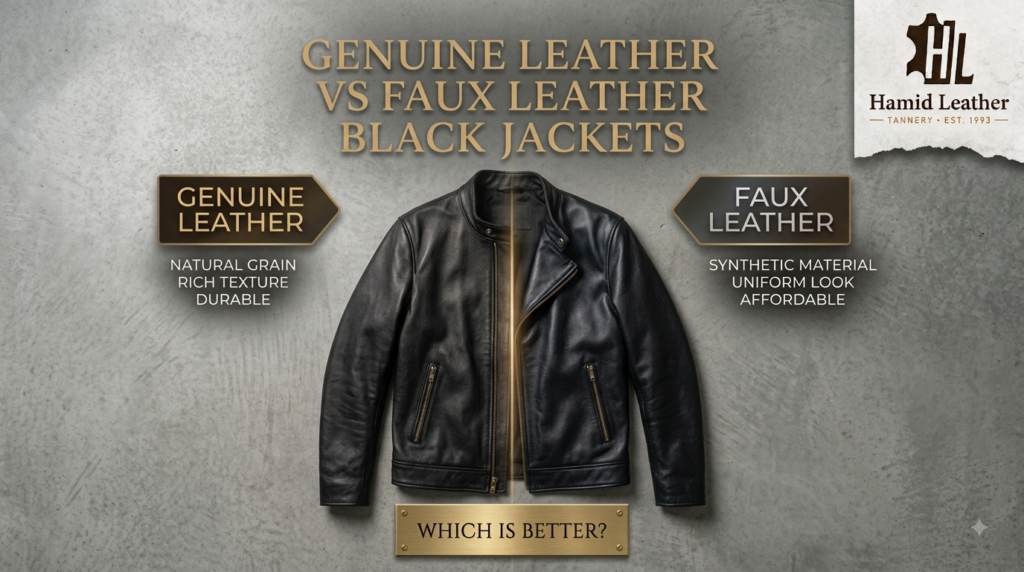
Black jackets are available in both genuine leather and faux leather, but the two materials differ significantly in composition, durability, appearance, comfort, maintenance and price.
Genuine leather is made from animal hides and is valued for its natural grain, strength and ability to develop character over time. Faux leather is a synthetic alternative, commonly produced using polyurethane (PU) or polyvinyl chloride (PVC), designed to imitate the appearance of natural leather.
Neither material is automatically suitable for every customer or clothing collection. Genuine leather is generally preferred for durability, ageing and premium positioning, while faux leather is often selected for affordability, consistent appearance and animal-free fashion products.
This guide compares genuine leather vs faux leather black jackets to help consumers, fashion brands, wholesalers and retailers choose the most appropriate material.
Genuine Leather vs Faux Leather at a Glance
| Feature | Genuine leather | Faux leather |
|---|---|---|
| Material source | Animal hide | Synthetic or partly bio-based material |
| Appearance | Natural grain and variation | Consistent and uniform |
| Durability | Generally high | Usually lower |
| Ageing | Can develop a natural patina | May peel or crack |
| Breathability | Generally better | Often limited |
| Initial price | Usually higher | Usually lower |
| Weight | Depends on the hide | Often lightweight |
| Water resistance | Requires care | Often resists light moisture |
| Maintenance | Needs suitable leather care | Usually easy to wipe clean |
| Repairability | Can often be conditioned or refinished | Usually difficult to repair |
| Consistency | Natural variation | High visual consistency |
| Best suited to | Premium and long-lasting jackets | Affordable and trend-focused jackets |
Genuine leather is usually the better option for longevity, natural character and premium collections. Faux leather may be more suitable when affordability, uniformity and animal-free materials are the main priorities.
What Is Genuine Leather?
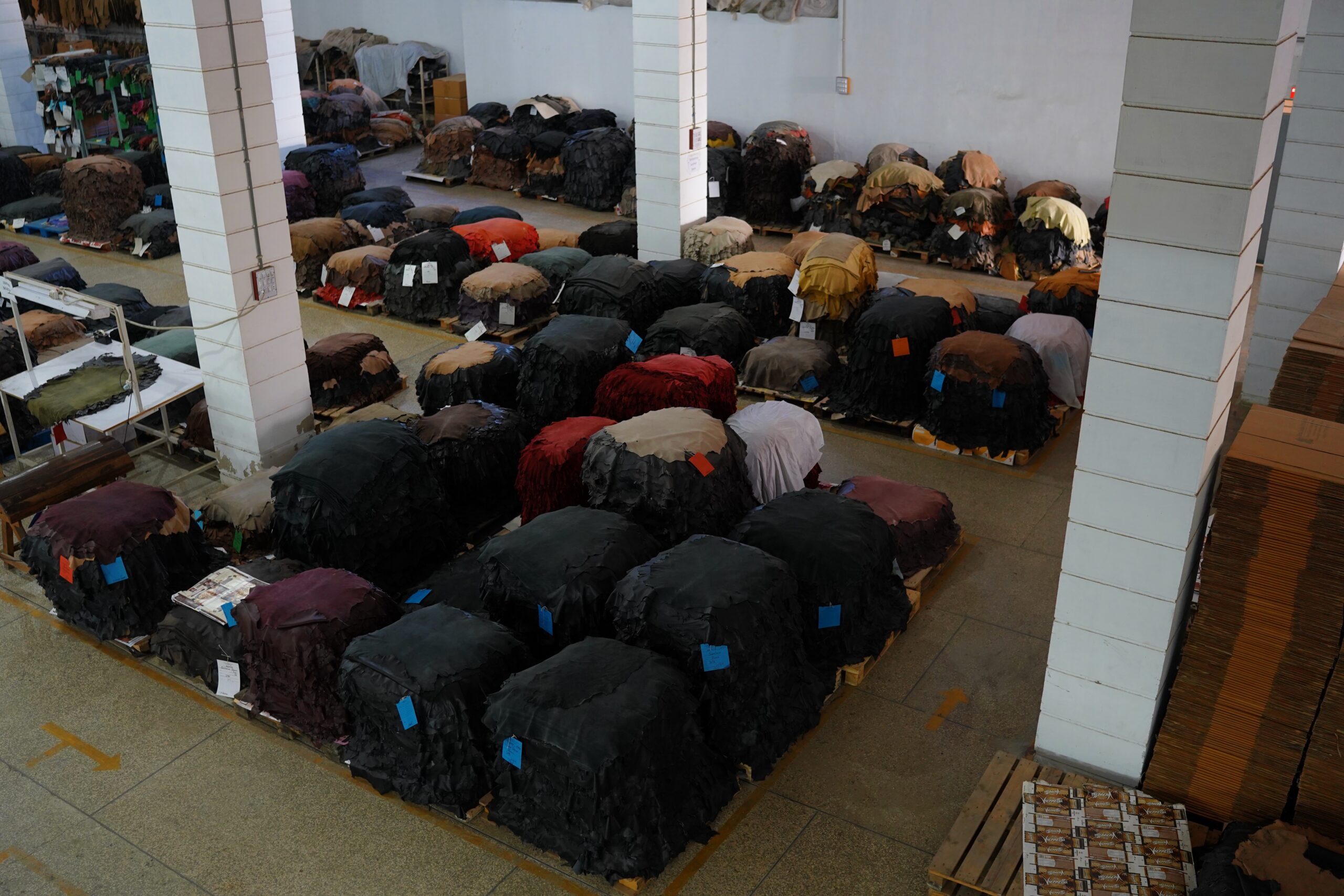
Genuine leather is produced from animal hides that have been preserved through tanning. Common leather types used for black jackets include:
- Cowhide
- Sheepskin
- Lambskin
- Goatskin
- Buffalo leather
- Calfskin
Each leather type provides different characteristics.
Cowhide is generally strong and structured, making it suitable for biker jackets, café racers and rugged outerwear. Sheepskin and lambskin are softer and lighter, while goatskin offers an effective balance between strength and flexibility.
The phrase “genuine leather” does not describe a specific level of quality. A jacket may use full-grain, top-grain, corrected-grain or split leather, and each option can differ in durability, appearance and price.
Buyers should therefore examine the complete leather specification instead of relying only on the word “genuine.”
What Is Faux Leather?
Faux leather is a manufactured material designed to resemble genuine leather. It usually consists of a fabric base covered with a synthetic coating.
The most common types include:
PU Leather
Polyurethane leather is generally soft, flexible and lightweight. It is frequently used for fashion jackets because it can imitate the smooth appearance of genuine leather at a lower price.
PVC Leather
PVC leather normally has a thicker and less breathable surface. It can offer good resistance to moisture but may feel stiffer than PU leather.
Bio-Based Leather Alternatives
Some newer materials use components derived from plants, agricultural waste or recycled sources. These may include materials marketed using cactus, grape, apple, mushroom or pineapple-related terminology.
However, many bio-based alternatives still contain synthetic binders or coatings. Buyers should request detailed composition information instead of assuming that a plant-related name means the material is entirely natural or biodegradable.
Which Material Looks Better?
The better appearance depends on the desired style.
Genuine leather displays natural grain, pores and subtle variations. These characteristics can make each jacket look slightly different. Over time, the surface may develop creases, tonal changes and a patina that reflects how the jacket has been worn.
Faux leather usually provides a more uniform surface. Its colour, grain and gloss can be controlled closely during manufacturing, which is useful for fashion collections requiring consistency across large quantities.
A high-quality faux leather can look convincing when new. However, lower-quality materials may appear excessively glossy, plastic-like or flat.
Genuine leather is normally better for brands seeking natural character and premium appeal. Faux leather is useful for clean, consistent and trend-driven designs.
Which Material Is More Durable?
Genuine leather is generally more durable than faux leather.
High-quality cowhide, goatskin and other suitable garment leathers can withstand years of regular use when the jacket is properly constructed and maintained.
Genuine leather fibres are naturally interconnected, allowing the material to flex and soften over time. Surface scratches and signs of wear may sometimes be reduced through conditioning or professional refinishing.
Faux leather has a coated structure. As the material ages, its surface may:
- Crack
- Peel
- Flake
- Separate from the backing
- Become sticky
- Lose flexibility
- Develop permanent creases
Once the synthetic coating begins to peel extensively, repairs are often difficult and may only provide a temporary improvement.
The lifespan of either jacket still depends on material quality, thickness, construction, climate, frequency of use and care.
Which Material Is More Comfortable?
Genuine leather usually becomes more comfortable with wear.
Natural leather can adapt gradually to the wearer’s body, particularly around the shoulders, elbows and sleeves. Its breathability also helps reduce heat and moisture build-up.
The initial comfort depends on the leather type. Lambskin and sheepskin are normally soft from the first wear, while thick cowhide may require a break-in period.
Faux leather can feel soft and flexible when new, especially when high-quality PU is used. However, synthetic coatings generally allow less airflow. This may make a faux leather jacket feel warm or clammy in mild conditions.
The lining, pattern and fit are also important. A well-designed faux leather jacket may feel more comfortable than a poorly fitted genuine leather one.
Which Material Is More Breathable?
Genuine leather is generally more breathable than synthetic leather.
Its natural fibre structure allows a limited exchange of heat and moisture. This can make it more comfortable during extended wear.
Faux leather usually has a less breathable coated surface. The wearer may experience greater heat and perspiration, particularly when the jacket uses a non-breathable lining.
Perforations, ventilation panels and moisture-managing linings can improve comfort, but they do not make faux leather perform exactly like natural leather.
Weight and Flexibility
The weight of a jacket depends on material thickness, backing, lining, hardware and design.
Genuine leather can range from lightweight lambskin to heavy cowhide or buffalo leather. This gives manufacturers several options for different jacket styles.
Faux leather is often lightweight, although thick PVC-based materials can feel heavy and stiff.
For lightweight fashion jackets, both sheepskin and high-quality PU can provide flexibility. For structured biker jackets, cowhide normally offers better shape retention and strength.
Manufacturers should match the material’s weight and flexibility to the pattern rather than selecting it solely by price.
How Do the Materials Age?
Genuine leather and faux leather age in very different ways.
How Genuine Leather Ages
Quality genuine leather may:
- Become softer
- Develop natural creases
- Gain tonal variation
- Form a patina
- Show character around seams and edges
- Adapt to the wearer’s shape
These changes are often considered desirable, especially in biker, bomber and heritage-inspired jackets.
How Faux Leather Ages
Faux leather may remain visually consistent during its early use. As the coating deteriorates, however, it can begin to crack or peel.
This deterioration is not the same as a natural leather patina. Once large sections of the surface separate from the fabric backing, restoring the original appearance can be difficult.
Storage conditions also matter. Excessive heat, humidity, friction and prolonged folding can accelerate damage to faux leather.
Water and Weather Resistance
Neither material should automatically be treated as completely waterproof.
Faux leather usually resists light rain and surface moisture because of its synthetic coating. It can normally be wiped clean easily.
However, water may enter through seams, zips or damaged areas. Excessive moisture can also affect the fabric backing or cause coatings to separate.
Finished genuine leather may tolerate light moisture, but repeated soaking can cause:
- Staining
- Stiffness
- Colour changes
- Loss of natural oils
- Surface damage
- Distortion
If a genuine leather jacket becomes wet, it should be allowed to dry naturally on a supportive hanger away from direct heat.
Protective products should be tested on a hidden area because they may change the black shade, grain or gloss.
Maintenance Requirements
Caring for Genuine Leather
Genuine leather normally requires more specialised care.
Recommended practices include:
- Removing dust with a soft cloth
- Using products made for garment leather
- Conditioning only when necessary
- Drying wet leather naturally
- Storing the jacket on a wide hanger
- Keeping it away from prolonged sunlight
- Avoiding permanent plastic storage
- Using professional cleaning for serious stains
Different leather types require different products. A conditioner suitable for cowhide may not be appropriate for delicate lambskin, suede or nubuck.
Caring for Faux Leather
Faux leather is generally easier to clean.
It can often be maintained by:
- Wiping it with a soft, slightly damp cloth
- Removing spills promptly
- Avoiding abrasive cleaners
- Keeping it away from strong heat
- Storing it without tight folds
- Following the manufacturer’s care label
Conditioners designed for genuine leather should not be applied unless the faux leather manufacturer specifically recommends them.
Which Is Easier to Repair?
Genuine leather is generally more repairable.
Depending on the damage, a leather specialist may be able to:
- Reduce minor scratches
- Restore lost colour
- Replace damaged panels
- Repair seams
- Condition dry areas
- Refinish worn surfaces
- Replace zips and hardware
Deep tears and extensive damage can still be difficult or expensive to repair, but genuine leather normally offers more restoration possibilities.
Faux leather is harder to restore once the coating starts peeling. Small damaged areas may sometimes be covered temporarily, but widespread deterioration often requires panel replacement or replacement of the complete jacket.
Price Differences
Faux leather jackets are generally less expensive than genuine leather jackets.
The lower price results from factors such as:
- More consistent sheet production
- Lower material cost
- Easier cutting
- Fewer natural defects
- Higher material utilisation
- Reduced panel-matching requirements
- Large-scale manufacturing efficiency
Genuine leather usually costs more because hides must be selected, tanned, graded and cut carefully. Natural defects and variations also affect cutting yield.
However, price varies significantly within both categories. Premium synthetic materials may cost more than low-grade split leather, while carefully selected full-grain or lambskin leather may command a much higher price.
Buyers should compare the material specification, construction and expected lifespan rather than considering the purchase price alone.
Cost per Wear
Although a genuine leather jacket normally costs more initially, it may provide better value over time if it remains wearable for many years.
For example, a more expensive jacket used regularly for a decade may have a lower cost per wear than several cheaper jackets that require replacement.
Faux leather may still offer good value for customers who:
- Wear jackets occasionally
- Follow short-term trends
- Have a limited budget
- Prefer animal-free materials
- Want multiple colours or designs
- Do not expect long-term use
The better value depends on how frequently the jacket will be worn and how long the customer expects to keep it.
Genuine Leather Grades
Understanding leather grades helps buyers assess quality more accurately.
Full-Grain Leather
Full-grain leather retains the natural outer grain. It is valued for its strength, visible character and ability to develop a patina.
Top-Grain Leather
Top-grain leather may be lightly corrected to create a smoother and more consistent surface. It is widely used for premium and commercial leather jackets.
Corrected-Grain Leather
Corrected-grain leather receives more surface treatment to reduce visible imperfections. An artificial grain may be embossed onto the surface before a pigmented finish is applied.
Split Leather
Split leather comes from the lower layer of a hide. It may receive a synthetic coating to imitate the appearance of higher-grade leather.
A coated split-leather jacket can sometimes resemble faux leather. Buyers should request written specifications to understand the actual construction.
How to Tell Genuine Leather from Faux Leather
It may be difficult to identify the material from photographs alone. Buyers should combine several checks.
Check the Product Label
Look for clear terms such as:
- Cow leather
- Sheep leather
- Lamb leather
- Goat leather
- PU
- Polyurethane
- PVC
- Synthetic leather
Labels such as “leather look,” “vegan leather” or “imitation leather” normally indicate a non-animal material.
Examine the Grain
Genuine leather may show small natural variations in pores and grain. Faux leather often has a repeated or highly uniform embossed pattern.
However, corrected genuine leather can also appear uniform, so grain alone is not conclusive.
Inspect a Visible Edge
Natural leather generally has a fibrous internal structure. Faux leather may reveal a woven fabric or synthetic backing.
Do not cut or damage the jacket. Inspect only naturally visible areas.
Feel the Material
Genuine leather may feel warm, flexible and naturally textured. Faux leather may feel smoother, cooler or more plastic-like.
High-quality synthetic materials can closely imitate natural leather, making touch an unreliable test when used alone.
Read the Specifications
The safest approach is to obtain a complete and accurate material description from the seller or manufacturer.
For a broader evaluation of materials, stitching, hardware and construction, read this guide on how to identify a high-quality black leather jacket.
Best Jacket Styles for Genuine Leather
Genuine leather works particularly well for products intended to provide durability, structure and long-term use.
Biker Jackets
Cowhide supports heavy zips, lapels, belts and reinforced panels effectively.
Café Racer Jackets
The clean silhouette highlights the natural grain and finish of the leather.
Bomber Jackets
Cowhide, goatskin and sheepskin can all be used depending on the required weight and softness.
Aviator Jackets
Genuine shearling provides natural wool insulation and an authentic winter appearance.
Leather Blazers
Soft lambskin or sheepskin can create a refined drape suitable for tailored designs.
Heritage Jackets
Waxed, oiled or distressed leather develops character and supports a vintage appearance.
Best Jacket Styles for Faux Leather
Faux leather is particularly useful for affordable, seasonal and trend-focused designs.
Fashion Biker Jackets
PU can recreate the appearance of a biker jacket without the weight or price of thick cowhide.
Cropped Jackets
Lightweight faux leather works well for short, fashion-led silhouettes.
Oversized Jackets
Synthetic materials can create a consistent appearance across broad panels.
Colour-Blocked Designs
Faux leather can be produced in controlled colours and finishes, helping manufacturers achieve consistent combinations.
Promotional or Costume Jackets
Lower-cost synthetic materials may suit products intended for occasional use.
Trend-Based Collections
Retailers can introduce current shapes and finishes at more accessible price points.
Is Faux Leather Always Vegan?
Faux leather is generally animal-free, but buyers should not assume that every jacket marketed as vegan meets a complete vegan standard.
Other components may include:
- Animal-based glues
- Wool-blend linings
- Horn buttons
- Shell components
- Leather labels or trims
- Animal-derived processing materials
Brands making vegan claims should verify the entire product, not only the outer material.
They should also avoid assuming that “vegan” automatically means biodegradable, plastic-free or environmentally harmless.
Environmental Considerations
The environmental comparison between genuine and faux leather is complex.
Genuine leather production may involve:
- Livestock-related impacts
- Water use
- Chemical tanning
- Wastewater
- Energy consumption
- Solid waste
- Transport
- Finishing chemicals
Synthetic leather production may involve:
- Fossil-based raw materials
- Plastic coatings
- Solvents
- Energy use
- Limited biodegradability
- Microplastic concerns
- Difficult recycling
- Shorter product life
A durable genuine leather jacket that is worn for many years has a different impact profile from a short-lived leather product. Similarly, a well-designed synthetic jacket used extensively may perform better than a poorly made product replaced frequently.
Responsible evaluation should consider:
- Material composition
- Traceability
- Chemical management
- Energy source
- Wastewater treatment
- Product lifespan
- Repairability
- Recycled content
- End-of-life options
- Evidence supporting environmental claims
Brands should request documented information rather than relying on general labels such as “eco-friendly,” “sustainable” or “green.”
Which Is Better for Cold Weather?
The outer material alone does not determine warmth.
A jacket’s cold-weather performance also depends on:
- Lining
- Insulation
- Collar design
- Cuff construction
- Jacket length
- Front closure
- Wind resistance
- Layering space
A quilted faux leather jacket may be warmer than an unlined lambskin jacket. However, genuine shearling usually provides much greater natural insulation because the wool remains attached to the hide.
For winter collections, buyers should evaluate the complete jacket specification instead of choosing only between genuine and faux leather.
Which Is Better for Everyday Wear?
Genuine leather is normally better for customers seeking a jacket for frequent, long-term use. It can soften, adapt to the body and remain attractive when maintained properly.
Faux leather can be practical for everyday fashion when the customer prioritises:
- Low initial cost
- Easy cleaning
- Lightweight construction
- Animal-free materials
- Consistent colour
- Shorter-term use
Climate also matters. Faux leather may feel less comfortable in warm or humid conditions because of its limited breathability.
Which Is Better for B2B Production?
Brands, retailers and wholesalers should select the material according to their target market and product positioning.
Genuine leather may be more appropriate for:
- Premium collections
- Long-lasting products
- Heritage brands
- Luxury fashion
- Rugged outerwear
- Repairable garments
- Customers seeking natural materials
Faux leather may be more suitable for:
- Entry-level prices
- Fast-moving trends
- Animal-free collections
- Highly consistent surfaces
- Promotional products
- Seasonal fashion
- Large colour ranges
Before placing a bulk order, buyers should approve:
- Material composition
- Thickness
- Weight
- Backing fabric
- Grain pattern
- Black shade
- Gloss level
- Flexibility
- Colourfastness
- Hydrolysis resistance
- Abrasion performance
- Hardware
- Lining
- Labels
- Packaging
- A complete pre-production sample
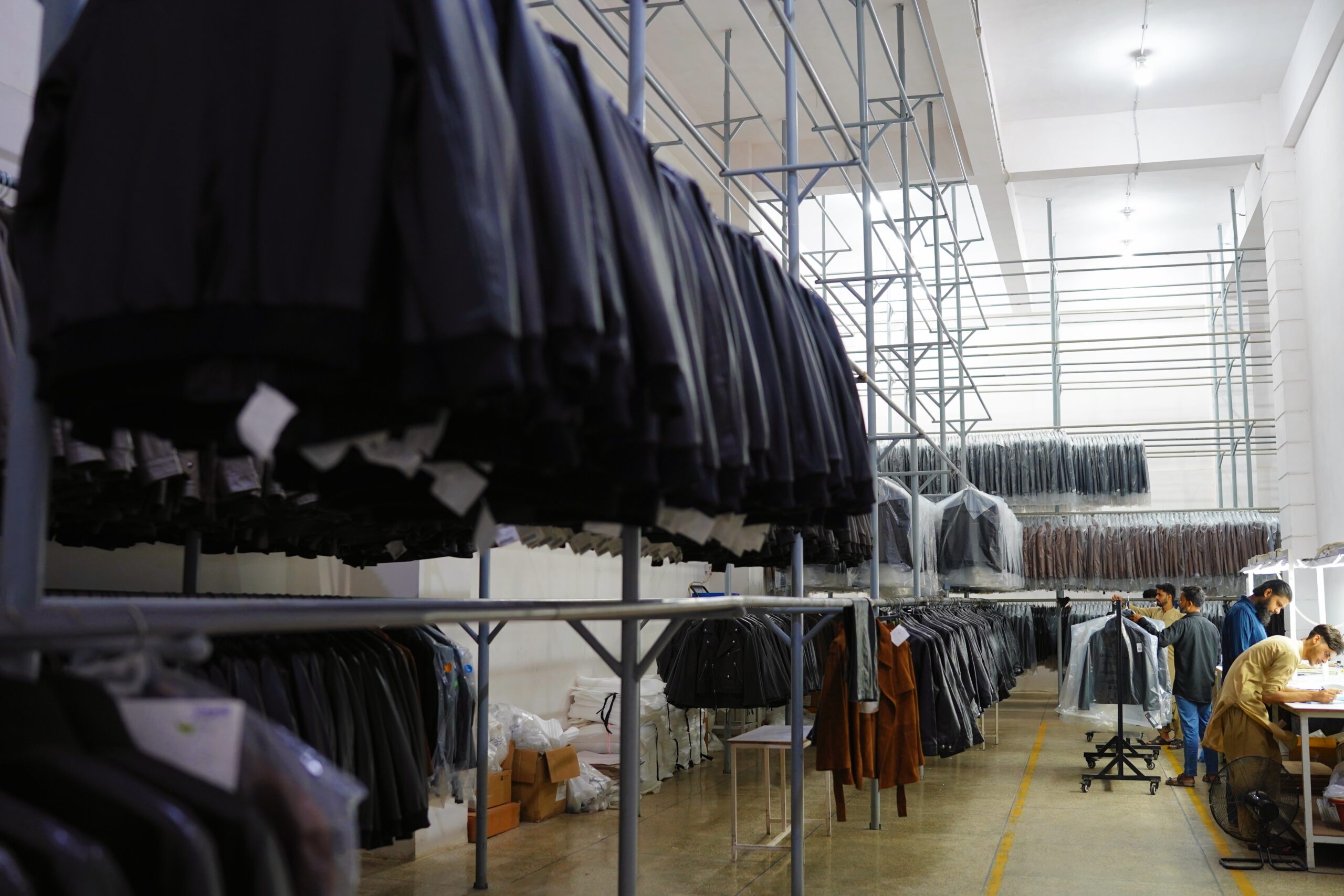
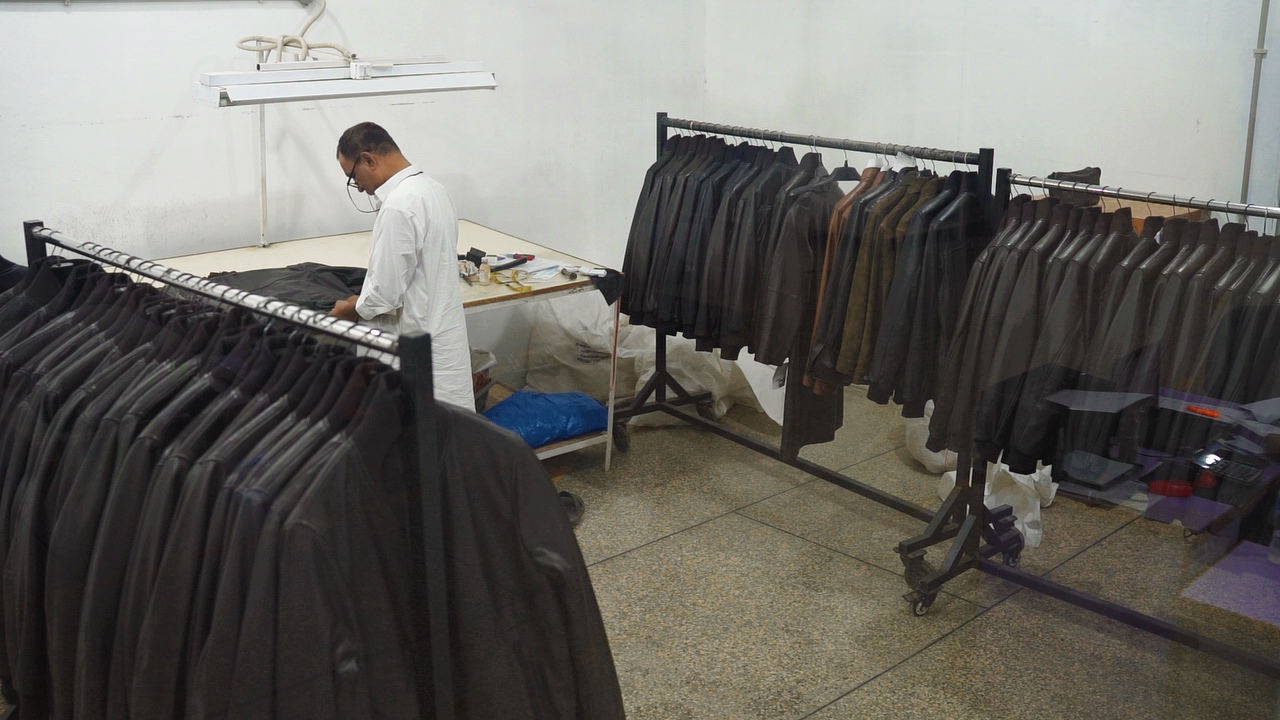
For custom leather garments and bulk jacket production, Hamid Leather Ltd works with international fashion brands, wholesalers and retailers.
Quality Checks for Genuine Leather Jackets
B2B buyers should inspect:
- Animal source and leather grade
- Hide thickness
- Grain consistency
- Black shade matching
- Surface-finish adhesion
- Panel matching
- Tear strength
- Flex resistance
- Wet and dry rubbing
- Stitching quality
- Reinforcement at stress points
- Hardware performance
- Lining construction
- Final measurements
Natural variation is expected, but it should remain within the approved quality standard.
Quality Checks for Faux Leather Jackets
Important checks include:
- Material composition
- Coating type
- Coating thickness
- Fabric backing
- Flex resistance
- Abrasion resistance
- Peel strength
- Hydrolysis resistance
- Cold-crack resistance
- Colourfastness
- Surface consistency
- Stretch and recovery
- Seam strength
- Hardware compatibility
Hydrolysis testing is particularly important for certain PU materials because moisture and heat can gradually weaken the coating.
A visually attractive sample may not represent long-term performance. Relevant physical testing should therefore be completed before bulk production.
Common Buying Mistakes
Assuming All Genuine Leather Is Premium
Genuine leather varies considerably in grade, tanning, finishing and construction. A poorly processed genuine leather jacket may perform worse than a well-made synthetic one.
Assuming Faux Leather Is Indestructible
Faux leather may resist light moisture, but heat, humidity, friction and age can cause the coating to crack or peel.
Judging Only by Softness
Softness does not prove quality. Both genuine and synthetic materials can be mechanically softened.
Ignoring the Lining and Hardware
A strong outer material cannot compensate for weak zips, poor stitching or an uncomfortable lining.
Believing Every Vegan Material Is Sustainable
Animal-free and environmentally sustainable are not identical claims. The complete composition and lifecycle must be assessed.
Approving Bulk Production from Photographs
Photographs cannot demonstrate thickness, flexibility, breathability, coating adhesion or seam strength. Buyers should approve physical materials and complete samples.
Frequently Asked Questions
Is genuine leather better than faux leather?
Genuine leather is generally better for durability, breathability, repairability and natural ageing. Faux leather is often better for affordability, consistency and animal-free fashion.
Does faux leather last as long as genuine leather?
Usually not. High-quality genuine leather normally lasts longer, while faux leather may eventually crack, peel or separate from its backing.
Is faux leather waterproof?
Faux leather often resists light moisture, but a complete jacket is not necessarily waterproof because water may enter through seams, zips and openings.
Does genuine leather peel?
High-quality leather does not normally peel like synthetic leather, but heavily coated genuine leather or bonded materials may experience surface separation.
Which material is easier to clean?
Faux leather is generally easier to wipe clean. Genuine leather requires products suitable for its specific type and finish.
Which material is more breathable?
Genuine leather is normally more breathable than PU or PVC faux leather.
Is faux leather suitable for winter?
It can be suitable when combined with an insulating lining, secure cuffs and an appropriate closure. The outer material alone does not determine warmth.
Which material is best for a biker jacket?
Cowhide is generally better for a durable and structured biker jacket. Faux leather is suitable for a lighter, affordable, fashion-focused version.
Can faux leather develop a patina?
Faux leather does not develop the same natural patina as genuine leather. Its coating may crease or wear, but this is different from natural leather ageing.
Is genuine leather always expensive?
Not always. Price depends on animal source, grade, thickness, finish, construction and brand positioning.
Is PU leather better than PVC leather?
PU leather is generally softer, lighter and more flexible. PVC may offer greater moisture resistance but can feel stiffer and less breathable.
Can faux leather be repaired?
Small areas may receive temporary cosmetic repairs, but extensive peeling or coating separation is difficult to restore permanently.
How can I identify genuine leather?
Check the label, material specification, grain, visible edges and backing. No single smell, touch or appearance test is completely reliable.
Is genuine leather more sustainable?
Not automatically. Sustainability depends on sourcing, tanning, chemical management, durability, repairability and product lifespan.
Is faux leather cruelty-free?
The outer material is normally animal-free, but buyers should verify glues, linings, labels and trims before describing the complete jacket as vegan.
Which material is better for wholesale production?
Genuine leather suits premium and durable collections, while faux leather works well for affordable and trend-focused ranges. The correct choice depends on the target customer and retail position.
Final Thoughts
The choice between genuine leather and faux leather black jackets depends on the customer’s priorities, budget and intended use.
Genuine leather is generally the stronger option for durability, breathability, natural character and long-term value. High-quality leather can soften with wear, develop a patina and remain usable for many years when maintained correctly.
Faux leather provides a more affordable and animal-free alternative. It offers consistent colour and grain, requires relatively simple cleaning and works well for seasonal or trend-focused fashion. However, it is usually less breathable and more likely to crack or peel as its coating ages.
Consumers should consider how often they will wear the jacket and how long they expect to keep it. Fashion brands and wholesale buyers should examine the complete material specification, physical performance, construction and target price before making a decision.
Ultimately, neither material should be judged by its name alone. A high-quality jacket combines an appropriate outer material with accurate cutting, secure stitching, reliable hardware, a comfortable lining and careful quality control.