Leather jackets are one of the most versatile and diverse categories in the fashion and outerwear industry. They come in many different styles, materials, finishes, fits, colours, and designs. From classic biker jackets and bomber jackets to aviator, racer, suede, shearling, and premium fashion jackets, the number of possible variations can make product organization difficult.
For manufacturers, wholesalers, B2B suppliers, online retailers, and fashion brands, understanding how to categorize leather jackets in product taxonomy correctly is essential. A well-planned taxonomy helps businesses organize products clearly, improve website navigation, enhance product discovery, and support search engine optimization.
When product categories are easy to understand, visitors can move from broad product groups to specific jacket types without confusion. This is particularly important for large leather jacket catalogues where buyers may want to filter products by material, style, gender, colour, finish, or intended use.
This guide explains how leather jackets should be categorized within an effective product taxonomy and how businesses can build a structure that works for both buyers and search engines.
What Is Product Taxonomy?
Product taxonomy is the structured system used to organize products into categories, subcategories, filters, and attributes.
A simple fashion taxonomy might look like this:
Clothing → Outerwear → Jackets → Leather Jackets
From there, leather jackets can be divided into more specific categories depending on how customers search for them.
For example:
Leather Jackets → Men’s Leather Jackets → Biker Jackets
or:
Leather Jackets → Women’s Leather Jackets → Bomber Jackets
A good taxonomy creates a clear relationship between different product groups. It helps customers understand where a product belongs and makes it easier for search engines to interpret the structure of a website.
For businesses with hundreds or thousands of products, taxonomy becomes especially important because customers need a fast and logical way to narrow down their choices.
Why Leather Jacket Product Taxonomy Is Important
Leather jackets are available in many variations, and poorly organized product catalogues can quickly become confusing.
A properly designed product taxonomy can help businesses:
- Improve website navigation
- Organize large product catalogues
- Improve internal linking
- Support SEO
- Make product filtering easier
- Improve product discovery
- Simplify inventory management
- Improve user experience
- Help buyers compare products
- Create clearer category pages
For B2B businesses, taxonomy is even more important because wholesale buyers often search according to specific commercial requirements.
For example, a buyer may want:
- Men’s cowhide biker jackets
- Women’s lambskin bomber jackets
- Full-grain leather jackets
- Private-label leather jackets
- Custom leather jackets
- Wholesale leather jackets
A strong taxonomy allows buyers to reach these product groups quickly.
Start With a Main Leather Jacket Category
The first step in learning how to categorize leather jackets in product taxonomy correctly is creating a strong primary category.
The basic structure may look like:
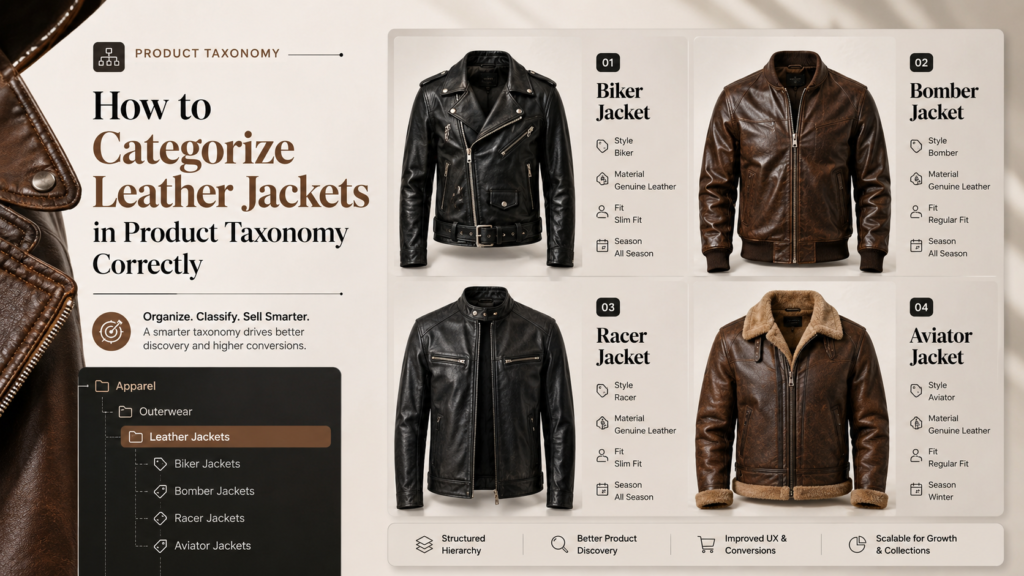
Apparel → Outerwear → Jackets → Leather Jackets
This creates a clear hierarchy and places leather jackets inside the broader clothing structure.
Once the main leather jacket category has been established, businesses can create subcategories based on characteristics that buyers commonly use when shopping.
The most useful characteristics include:
- Style
- Gender
- Leather type
- Finish
- Intended use
- Fit
- Colour
- Season
- Manufacturing requirements
However, not every characteristic should become a separate category. Some work better as filters.
Categorize Leather Jackets by Style
Style is one of the most useful ways to organize leather jackets because customers frequently search for a specific design.
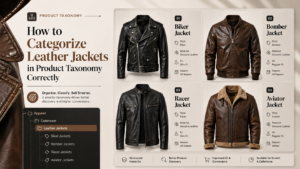
Leather Biker Jackets
Biker jackets are among the most recognizable leather jacket styles. They are commonly associated with asymmetrical zippers, lapels, metal hardware, fitted silhouettes, and multiple pockets.
A suitable taxonomy structure would be:
Leather Jackets → Biker Jackets
or:
Men’s Leather Jackets → Biker Jackets
Biker jackets may also be divided according to material, such as cowhide or lambskin.
Leather Bomber Jackets
Bomber jackets usually feature ribbed cuffs, ribbed waistbands, comfortable fits, and front zip closures.
A clear category structure would be:
Leather Jackets → Bomber Jackets
Bomber jackets can then be filtered by leather type, colour, gender, or lining.
Leather Aviator Jackets
Aviator jackets are inspired by traditional flight jackets and often include warm linings, large collars, and shearling-style details.
They can be categorized as:
Leather Jackets → Aviator Jackets
Some websites may also use the term “flight jackets,” depending on how customers search.
Leather Racer Jackets
Racer jackets, also known as café racer jackets, generally feature simple designs, streamlined silhouettes, stand collars, and minimal decoration.
They can be classified as:
Leather Jackets → Racer Jackets
or:
Leather Jackets → Café Racer Jackets
Leather Blazers
Leather blazers combine traditional tailoring with leather construction. They often appeal to customers looking for premium or smart-casual outerwear.
A suitable category would be:
Leather Jackets → Leather Blazers
Categorize Leather Jackets by Leather Type
The type of leather used is another important part of product taxonomy.
Different leather materials offer different levels of durability, softness, weight, texture, and appearance.
Cowhide Leather Jackets
Cowhide is known for its durability, strength, and natural grain. It is widely used for biker jackets, motorcycle jackets, workwear, and premium outerwear.
A typical category structure might be:
Leather Jackets → Cowhide Leather Jackets
Lambskin Leather Jackets
Lambskin leather is softer and lighter than cowhide. It is commonly used for fashion jackets where comfort and smooth texture are important.
A suitable classification is:
Leather Jackets → Lambskin Leather Jackets
Sheepskin Leather Jackets
Sheepskin is often used for lightweight jackets as well as warmer shearling-inspired designs.
It can be categorized as:
Leather Jackets → Sheepskin Leather Jackets
Goatskin Leather Jackets
Goatskin offers good durability, flexibility, and a distinctive grain pattern.
A useful taxonomy category would be:
Leather Jackets → Goatskin Leather Jackets
Categorize by Leather Quality and Finish
Leather quality and surface finish can also influence how jackets are organized.
Common leather quality classifications include:
- Full-grain leather
- Top-grain leather
- Corrected-grain leather
- Suede leather
- Nubuck leather
For example:
Leather Jackets → Full-Grain Leather Jackets
or:
Leather Jackets → Suede Jackets
Finishes can also be used as filters rather than separate categories.
Common finishes may include:
- Matte
- Glossy
- Vintage
- Distressed
- Waxed
- Washed
- Aniline
If every finish is turned into a separate category, the website may become overly complicated. In many cases, filters provide a cleaner solution.
Categorize Leather Jackets by Gender
Gender remains a common taxonomy layer within fashion websites.
A simple structure may include:
Leather Jackets
- Men’s Leather Jackets
- Women’s Leather Jackets
- Unisex Leather Jackets
Products can then be categorized further according to style.
For example:
Men’s Leather Jackets → Biker Jackets
Women’s Leather Jackets → Bomber Jackets
This creates a logical path that customers can follow.
Categorize Leather Jackets by Colour
Colour is an important buying factor, but it usually works better as a product filter than as a main category.
Popular leather jacket colours include:
- Black
- Brown
- Tan
- Burgundy
- Grey
- Navy
- White
Instead of creating separate top-level pages for every colour, businesses can allow customers to filter existing categories.
For example:
Men’s Leather Jackets → Biker Jackets → Black
This approach reduces duplicate content while keeping navigation simple.
Categorize by Intended Use
Leather jackets can also be classified according to how they are intended to be used.
Fashion Leather Jackets
These jackets are designed primarily for style, everyday wear, and seasonal fashion.
Motorcycle Leather Jackets
These jackets are designed for motorcycle-inspired use and may feature stronger construction, durable leather, or reinforced areas.
Casual Leather Jackets
Casual leather jackets are designed for everyday wardrobes and usually prioritize comfort and versatility.
Luxury Leather Jackets
Luxury leather jackets may use premium leather grades, specialized finishes, high-quality hardware, and more advanced construction techniques.
Wholesale Leather Jackets
Manufacturers and suppliers may also create a wholesale-focused category.
For example:
Leather Jackets → Wholesale Leather Jackets
This helps commercial buyers identify products that are available for bulk purchasing.
Product Taxonomy for B2B Leather Manufacturers
B2B manufacturers often need more detailed product taxonomy than standard retail websites because wholesale buyers search according to sourcing requirements.
Important B2B attributes may include:
- Leather material
- Jacket style
- Minimum order quantity
- Private-label availability
- Custom design options
- Colour customization
- Hardware customization
- Branding options
- Size ranges
- Lining options
- Production capacity
Manufacturers such as Hamid Leather can organize leather jacket collections by style, material, finishing options, and manufacturing capabilities so that international buyers can more easily identify suitable products for wholesale, private-label, or custom production requirements.
For B2B websites, this type of structure can make product sourcing more efficient and improve the overall buyer journey.
Use Product Attributes Alongside Categories
One of the biggest mistakes businesses make is turning every product feature into a separate category.
Not every attribute needs its own page.
Instead, businesses should combine categories with product filters.
Important leather jacket attributes can include:
- Leather type
- Leather grade
- Style
- Gender
- Colour
- Size
- Fit
- Lining
- Closure
- Collar style
- Pocket design
- Hardware
- Season
- Finish
- Customization
For example, a customer may navigate to:
Men’s Leather Jackets → Biker Jackets
and then apply filters such as:
Leather: Cowhide
Colour: Black
Fit: Regular
Finish: Distressed
This creates a much better shopping experience than creating individual category pages for every possible combination.
Create a Logical Category Hierarchy
A strong taxonomy should move from broad categories to specific ones.
For example:
Apparel
→ Outerwear
→ Jackets
→ Leather Jackets
→ Men’s Leather Jackets
→ Biker Jackets
→ Cowhide Biker Jackets
Another example could be:
Apparel
→ Outerwear
→ Leather Jackets
→ Women’s Leather Jackets
→ Bomber Jackets
→ Lambskin Bomber Jackets
This type of hierarchy is easy for both visitors and search engines to understand.
How Product Taxonomy Supports SEO
Product taxonomy plays an important role in SEO because it helps search engines understand how products and categories are connected.
A website that places every jacket inside a single broad category may miss opportunities to target more specific search terms.
Useful category pages may include:
- Men’s Leather Jackets
- Women’s Leather Jackets
- Black Leather Jackets
- Leather Biker Jackets
- Leather Bomber Jackets
- Cowhide Leather Jackets
- Full-Grain Leather Jackets
These category pages can target specific search intent while providing customers with useful navigation.
However, businesses should avoid creating hundreds of nearly identical pages simply to target keywords.
Every category should have a clear purpose and should help users navigate the website.
Keep Category Names Consistent
Consistency is essential when creating product taxonomy.
For example, a website should avoid using different names for the same category, such as:
- Biker Leather Jackets
- Motorcycle Jackets
- Motorbike Leather Jackets
- Leather Motorcycle Coats
Unless these products are genuinely different, using multiple category names can create confusion.
Instead, choose one primary category such as:
Leather Biker Jackets
Other related terms can then appear naturally within product descriptions, headings, and metadata.
Avoid Over-Categorization
Over-categorization is another common problem.
For example, creating separate categories such as:
Black Men’s Cowhide Biker Jackets
Brown Men’s Cowhide Biker Jackets
Black Men’s Lambskin Biker Jackets
can quickly produce hundreds of thin category pages.
A better approach would be:
Men’s Leather Jackets → Biker Jackets
with filters for:
- Colour
- Leather
- Finish
- Size
- Fit
This keeps the website scalable and easy to manage.
Consider Buyer Search Behaviour
A successful product taxonomy should reflect how real customers search.
Some customers begin with style:
Leather Bomber Jackets
Others begin with material:
Cowhide Leather Jackets
B2B buyers may search using commercial terms such as:
Leather Jacket Manufacturer
Wholesale Leather Jacket Supplier
Private-Label Leather Jackets
Understanding buyer intent helps businesses decide which characteristics deserve dedicated category pages and which should remain product filters.
Example of an Effective Leather Jacket Taxonomy
A well-organized leather jacket catalogue might look like this:
Leather Jackets
By Gender
- Men’s Leather Jackets
- Women’s Leather Jackets
- Unisex Leather Jackets
By Style
- Biker Jackets
- Bomber Jackets
- Aviator Jackets
- Racer Jackets
- Leather Blazers
By Leather
- Cowhide Jackets
- Lambskin Jackets
- Sheepskin Jackets
- Goatskin Jackets
By Finish
- Full-Grain Leather
- Suede
- Nubuck
- Distressed Leather
Product Filters
- Colour
- Size
- Fit
- Lining
- Closure
- Collar
- Hardware
- Season
This structure gives customers multiple ways to discover products without making navigation unnecessarily complicated.
Common Leather Jacket Taxonomy Mistakes
Businesses should avoid several common mistakes when categorizing leather jackets.
These include:
- Creating too many top-level categories
- Mixing filters with categories
- Using inconsistent category names
- Creating duplicate category pages
- Ignoring buyer search behaviour
- Creating thin SEO pages
- Failing to update taxonomy as the catalogue grows
A good taxonomy should remain simple enough for customers to understand but detailed enough to support large product catalogues.
Final Thoughts
Understanding how to categorize leather jackets in product taxonomy correctly is essential for building an organized, scalable, and SEO-friendly product catalogue.
The best approach is to begin with a broad leather jacket category and then organize products according to meaningful characteristics such as style, gender, leather type, and intended use. Secondary characteristics such as colour, size, fit, lining, hardware, and finish can then be handled through filters.
For manufacturers, wholesalers, retailers, and B2B leather suppliers, a strong product taxonomy does more than organize products. It improves website navigation, supports internal linking, helps search engines understand product relationships, and makes it easier for buyers to find exactly what they need.
By keeping categories logical, consistent, and aligned with buyer behaviour, leather businesses can create a product structure that remains effective even as their collections continue to expand.