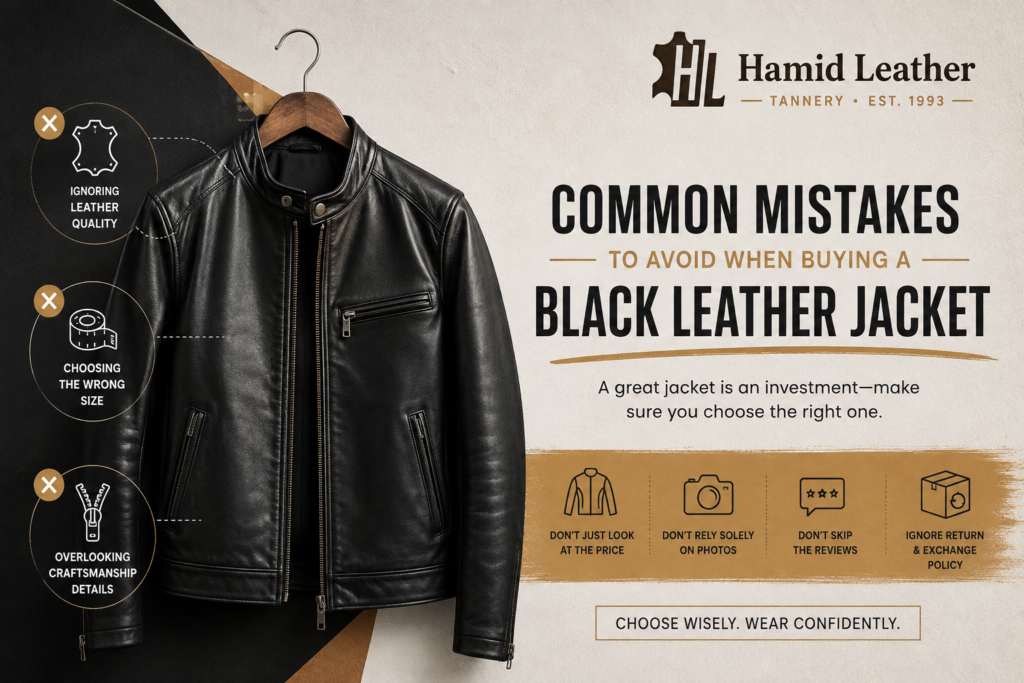
Buying a black leather jacket can be a long-term investment, but choosing the wrong material, size, style or construction can lead to an expensive disappointment.
Many buyers focus only on appearance or price. However, a jacket that looks attractive in photographs may use unsuitable leather, weak hardware, inaccurate sizing or poor-quality stitching. These problems can affect its comfort, durability and overall value.
Whether you are purchasing one jacket for personal use or sourcing a collection for a fashion brand, avoiding common buying mistakes will help you make a better decision.
This guide explains the most common mistakes to avoid when buying a black leather jacket and shows you how to evaluate its leather, fit, finish, construction and long-term value.
Mistake 1: Buying Based Only on Appearance
The appearance of a black leather jacket is important, but it should not be the only factor influencing your decision.
Professional lighting, editing and carefully selected product samples can make a jacket look impressive online. Photographs may not reveal:
- Leather thickness
- Surface flexibility
- Stitching quality
- Hardware strength
- Lining construction
- Actual weight
- Comfort
- Fit problems
- Colour transfer
- Weak pocket construction
Review the complete product description and examine close-up images of the leather, stitching, zips, lining and interior labels.
If you are buying in person, inspect the jacket under natural or neutral lighting. Artificial shop lighting can make the black colour and surface finish appear different.
B2B buyers should never approve bulk production based only on digital photographs. Physical leather swatches and complete samples are necessary.
Mistake 2: Assuming All Genuine Leather Is the Same
The term “genuine leather” does not provide enough information to judge a jacket’s quality.
Genuine leather jackets can be produced from:
- Full-grain leather
- Top-grain leather
- Corrected-grain leather
- Split leather
- Heavily pigmented leather
- Coated leather
The phrase also does not identify the animal source.
A cowhide jacket will normally feel different from a lambskin or sheepskin jacket. Cowhide is generally stronger and more structured, while lambskin is softer, lighter and more refined.
Before purchasing, look for specific information about:
- Animal source
- Leather grade
- Thickness
- Surface finish
- Tanning method
- Grain
- Care requirements
- Intended use
Avoid sellers that rely entirely on broad phrases such as “premium genuine leather” without offering meaningful specifications.
Mistake 3: Choosing the Wrong Leather for Your Needs
No single leather type is suitable for every jacket or every buyer.
Choosing leather only because it is popular can result in a jacket that does not suit your lifestyle.
Cowhide
Cowhide is generally strong, substantial and suitable for structured jackets. It is often used for biker jackets, café racers and rugged outerwear.
However, thick cowhide may feel too heavy or warm for buyers who want a lightweight everyday jacket.
Sheepskin
Sheepskin is softer and lighter. It can provide excellent comfort for fashion jackets, bombers and fitted designs.
Its softer surface may require more careful handling than heavy cowhide.
Lambskin
Lambskin offers a smooth, luxurious feel and works well for lightweight, refined jackets. It may not be the best choice for demanding outdoor use or buyers who frequently expose their jackets to rough surfaces.
Goatskin
Goatskin provides a useful balance between strength, flexibility and manageable weight. Its natural grain may also help conceal minor signs of use.
Buffalo Leather
Buffalo leather is often substantial and strongly grained. It suits rugged and vintage-inspired designs but may feel too heavy for buyers who prefer a soft, minimal jacket.
Choose the leather according to the jacket’s intended use, climate, design and required durability.
Mistake 4: Believing That Thicker Leather Is Always Better
Leather thickness affects durability and structure, but thicker leather is not automatically higher quality.
Heavy leather may provide:
- Greater structure
- Strong shape retention
- Better abrasion resistance
- A substantial appearance
However, it can also create:
- Additional weight
- Restricted movement
- A longer break-in period
- Discomfort in warm weather
- Excessive bulk in fitted designs
Lightweight leather can be an excellent choice for blazers, fashion jackets and styles requiring a soft drape.
The correct thickness depends on the design. A slim lambskin jacket should not be judged by the same standards as a heavy cowhide biker jacket.
Mistake 5: Choosing the Wrong Jacket Style
A jacket may be well made but still become a poor purchase if the style does not suit your wardrobe or lifestyle.
Common black leather jacket styles include:
- Biker jackets
- Café racer jackets
- Bomber jackets
- Aviator jackets
- Leather blazers
- Field jackets
- Overshirts
- Long leather coats
Before choosing a style, consider:
- Your usual clothing
- Your preferred fit
- The occasions when you will wear it
- Local weather
- Required layering
- Your body proportions
- The level of maintenance you accept
A heavily decorated biker jacket may not suit someone who mainly wears smart-casual clothing. Similarly, a fitted café racer may not provide enough layering space for cold winter use.
Classic, balanced designs usually offer greater long-term versatility.
Mistake 6: Selecting a Size Based Only on S, M or L
Standard size labels are not consistent across all manufacturers.
A medium from one brand may have different chest, shoulder, sleeve and body measurements from a medium produced by another company.
Always review the exact size chart and determine whether it lists:
- Body measurements
- Finished garment measurements
- Centimetres or inches
- Slim, regular or relaxed fit
- Measurement tolerances
Body measurements describe the wearer, while garment measurements describe the finished jacket. A jacket must contain additional space for comfort, movement and layering.
Confusing these two systems can lead to choosing the wrong size.
Mistake 7: Ignoring the Shoulder Fit
The shoulders are among the most difficult and expensive areas of a leather jacket to alter.
For a standard or slim fit, the shoulder seams should generally align with your natural shoulder points. They should not sit significantly above the shoulders or extend too far down the arms unless the jacket intentionally uses an oversized design.
A jacket may be too small if:
- The shoulder seams sit above your shoulders
- The leather pulls strongly across the upper back
- The collar moves backwards
- The armholes feel painful
- You cannot reach forward comfortably
It may be too large if:
- The shoulder seams fall unintentionally down the arms
- The sleeves appear excessively long
- The upper body looks shapeless
- The collar does not sit correctly
Choose the correct shoulder fit before considering minor alterations elsewhere.
Mistake 8: Expecting the Leather to Stretch Dramatically
Natural leather can soften and adapt slightly with wear, particularly around the elbows, shoulders and waist.
However, it will not reliably stretch several sizes.
Do not buy a jacket that:
- Restricts your breathing
- Cannot close properly
- Causes pain
- Creates severe pulling lines
- Distorts the front zip
- Prevents normal arm movement
- Places extreme pressure on the seams
A new cowhide jacket may feel firm, but it should still permit essential movement. Depending on dramatic stretching can leave you with an uncomfortable and unusable garment.
Mistake 9: Forgetting About Layering
A jacket that fits well over a T-shirt may become uncomfortable when worn over a jumper or hoodie.
Before selecting a size, decide what you will normally wear underneath it.
Possible layers include:
- T-shirts
- Shirts
- Polo shirts
- Lightweight knitwear
- Sweatshirts
- Hoodies
- Thermal clothing
- Thick winter jumpers
If possible, try the jacket with your intended layer.
The shoulders, chest, armholes and upper sleeves should provide enough room without making the jacket look excessively large when worn over lighter clothing.
Mistake 10: Failing to Perform a Movement Test
Do not judge a leather jacket only while standing still.
Close the jacket and perform several ordinary movements:
- Raise both arms
- Reach forward
- Cross your arms
- Bend your elbows
- Turn your upper body
- Sit down
- Place your hands inside the pockets
- Move your head from side to side
Some resistance may be normal with new, thick leather. However, the jacket should not cause pain, restrict breathing or place severe tension on the seams.
If the entire jacket rises significantly when you lift your arms, the armholes may be too low or the pattern may not suit your body.
Mistake 11: Ignoring Sleeve and Body Length
The correct length depends on the jacket’s design.
For most leather jackets, the sleeves should end around the wrist bone or slightly below it when your arms are relaxed. Motorcycle-inspired jackets may use slightly longer sleeves to provide coverage when the arms extend forward.
The body length may vary:
- Biker jacket: waist or upper hip
- Café racer: waist or upper hip
- Bomber jacket: around the waist
- Aviator jacket: waist to hip
- Leather blazer: below the hip
- Long leather coat: upper thigh or lower
Check the sleeve and body length while moving and sitting, not only while standing.
Avoid selecting a larger size only to gain additional sleeve length. This can make the shoulders, chest and waist unnecessarily wide. Tall sizing or custom measurements may provide a better solution.
Mistake 12: Ignoring the Upper Arms and Armholes
Buyers often measure the chest but overlook the biceps and armholes.
This is especially important for athletic or muscular wearers. A jacket may fit correctly around the waist but feel restrictive through the shoulders and upper arms.
Check whether you can:
- Bend your elbows comfortably
- Raise your arms
- Reach forward
- Wear your intended layers
- Move without severe underarm pressure
Simply choosing a larger standard size may provide more arm space but make the waist excessively loose. An athletic cut or custom sizing may produce a better result.
Mistake 13: Focusing Only on Softness
Soft leather can feel luxurious, but softness alone does not prove quality.
Leather may be softened mechanically or treated with heavy coatings to create an attractive first impression.
Evaluate softness alongside:
- Tensile strength
- Tear resistance
- Surface finish
- Thickness
- Flexibility
- Panel consistency
- Intended use
- Construction quality
A structured cowhide jacket is expected to feel firmer than a lambskin fashion jacket. Judging both products by softness alone would be misleading.
The leather should feel suitable for the design rather than simply as soft as possible.
Mistake 14: Overlooking the Black Finish
The black finish affects the jacket’s appearance, colour stability and ageing behaviour.
Black leather may have a:
- Matte finish
- Semi-matte finish
- Glossy finish
- Waxed surface
- Oiled finish
- Distressed effect
- Vintage finish
- Two-tone appearance
Look for a finish that bends naturally with the leather. It should not crack, peel or separate when the jacket moves.
Check for:
- Consistent black colour
- Balanced gloss
- Flexible finishing
- Excessive colour transfer
- Sticky areas
- Blisters
- Early surface cracking
A clean white cloth can be rubbed gently over an inconspicuous area to check colour transfer. Minor transfer may occur with some waxed or lightly finished leathers, but heavy transfer can indicate weak colourfastness.
Mistake 15: Expecting Completely Identical Natural Grain
Natural leather can contain small differences in grain, pores, wrinkles and texture.
These variations do not automatically indicate poor quality. In many cases, they demonstrate the natural characteristics of the hide.
However, the panels should still appear balanced.
Look for reasonable consistency across:
- Front panels
- Sleeves
- Shoulders
- Collar
- Back sections
- Pocket areas
One sleeve should not look dramatically darker, glossier or more heavily grained than the other unless the design intentionally uses contrast.
The mistake is either rejecting all natural variation or accepting severe panel mismatch as unavoidable.
Mistake 16: Failing to Inspect the Stitching
Good leather cannot compensate for weak stitching.
Inspect the seams around:
- Shoulders
- Armholes
- Pockets
- Collar
- Cuffs
- Side panels
- Sleeve attachments
- Front closure
- Hem
Good stitching should be straight, secure and evenly spaced.
Warning signs include:
- Loose threads
- Skipped stitches
- Crooked seam lines
- Open seams
- Uneven stitch lengths
- Poor thread tension
- Excessive puckering
- Multiple visible needle holes
Leather retains needle holes permanently. Repeatedly unpicking and restitching a seam can weaken the material and damage its appearance.
Mistake 17: Ignoring Stress-Point Reinforcement
Certain areas experience greater pressure during regular use.
These include:
- Pocket corners
- Underarms
- Shoulder seams
- Zip ends
- Belt attachments
- Cuff openings
- Snap fasteners
These areas should be reinforced appropriately.
Soft and lightweight leather can stretch around pockets, snaps and heavy hardware if suitable reinforcement is not used.
Open and close pockets, gently inspect the attachment points and check whether the leather appears strained around the hardware.
Mistake 18: Not Testing the Zips and Hardware
Zips, snaps, buckles and adjusters are used frequently. Weak hardware can make an otherwise attractive jacket frustrating or impossible to wear.
Test every component several times.
The hardware should:
- Move smoothly
- Remain properly aligned
- Feel securely attached
- Avoid catching the lining
- Have no sharp edges
- Match the jacket’s weight
- Use a consistent finish
A heavy zip is not automatically a sign of quality. Oversized hardware can distort lightweight leather, while a weak zip may be unsuitable for thick cowhide.
The hardware and leather should work together as part of the complete design.
Mistake 19: Overlooking the Lining
The lining affects comfort, warmth, movement and durability.
Common lining materials include:
- Polyester
- Viscose
- Cotton
- Satin
- Quilted polyester
- Wool blends
- Synthetic insulation
Inspect whether the lining:
- Sits smoothly
- Allows natural movement
- Is securely stitched
- Avoids twisting
- Does not hang below the hem
- Does not catch in the zip
- Provides sufficient room in the sleeves
A lining that is cut too tightly may restrict movement even when the leather shell has the correct measurements.
The lining should also suit the climate. Quilted insulation may be valuable in cold weather but uncomfortable in a mild or warm environment.
Mistake 20: Failing to Inspect the Pockets
Pockets are frequent stress points and should be inspected carefully.
Place your hands inside them and check:
- Pocket depth
- Placement
- Comfort
- Corner reinforcement
- Pocket-bag material
- Stitching
- Zip movement
- Snap alignment
Both sides should be positioned consistently.
Weak pocket bags may tear even when the leather exterior remains in good condition. Interior pockets should also be strong enough for the items they are designed to carry.
Mistake 21: Assuming a High Price Guarantees Quality
An expensive leather jacket is not automatically a high-quality jacket.
The price may reflect:
- Brand recognition
- Marketing
- Retail location
- Packaging
- Limited production
- Design exclusivity
- Distribution costs
- Celebrity promotion
Some premium jackets use excellent materials and skilled workmanship. Others may charge mainly for the brand name.
Evaluate the actual product by checking:
- Leather specifications
- Construction
- Fit
- Hardware
- Lining
- Stitching
- Finish
- Return policy
- Repairability
Compare jackets at different price levels using the same quality criteria.
Mistake 22: Choosing the Cheapest Jacket Without Comparing Specifications
The lowest-priced jacket may not provide the best value.
An unusually low price can sometimes indicate:
- Split or heavily coated leather
- Weak hardware
- Low-quality lining
- Poor stitching
- Limited quality control
- Inaccurate sizing
- Minimal after-sales support
However, an affordable price does not always mean poor quality. Direct manufacturing, simple designs and lower retail overheads can reduce costs.
Compare the materials and construction rather than using price alone as the deciding factor.
A moderately priced, well-made jacket can offer better long-term value than either a very cheap product or an overpriced designer jacket.
Mistake 23: Ignoring Cost per Wear
The purchase price does not provide a complete picture of value.
Cost per wear can be calculated as:
Cost per wear = Total ownership cost ÷ Number of times worn
Total ownership cost may include:
- Purchase price
- Delivery
- Import duties
- Alterations
- Cleaning
- Conditioning
- Repairs
A £400 jacket worn 200 times has a cost per wear of £2. A £100 jacket worn only ten times has a cost per wear of £10.
A jacket is more likely to provide good value when it fits comfortably, matches your wardrobe and suits your climate.
For a complete evaluation of durability, cost per wear and long-term value, read whether black leather jackets are worth the investment.
Mistake 24: Ignoring Your Local Climate
A leather jacket should match the weather conditions in which you expect to wear it.
A thick cowhide aviator jacket with a quilted lining may be excellent for cold conditions but impractical in a warm climate.
A lightweight sheepskin or lambskin jacket may provide greater value in mild temperatures.
Consider:
- Average temperature
- Humidity
- Rainfall
- Wind
- Seasonal changes
- Indoor use
- Outdoor use
- Layering needs
Leather is not completely waterproof. Prolonged exposure to heavy rain can affect its colour, finish and shape.
Mistake 25: Assuming Leather Is Waterproof
Leather can tolerate limited moisture depending on its finish, but it should not be treated as fully waterproof.
Heavy rain may cause:
- Water spots
- Colour changes
- Surface stiffness
- Distortion
- Finish damage
- Mould during incorrect drying
If the jacket becomes wet, allow it to dry naturally in a ventilated space. Keep it away from radiators, hair dryers and direct heat.
Before using a protective product, confirm that it is suitable for the specific leather and finish. Test it on a hidden area first.
Mistake 26: Ignoring Care Requirements
A leather jacket requires appropriate maintenance.
Before purchasing, consider whether you are willing to:
- Store it on a wide hanger
- Keep it in a ventilated space
- Avoid permanent plastic storage
- Protect it from prolonged sunlight
- Dry it naturally
- Use suitable leather-care products
- Arrange professional cleaning when necessary
- Repair damaged stitching promptly
Using the wrong cleaner or conditioner can darken the leather, alter the finish or leave permanent marks.
Suede, nubuck, lambskin, waxed leather and smooth cowhide may require different care methods.
Mistake 27: Removing Labels Before Checking the Jacket Properly
When buying online, do not remove the labels until you have completed a full inspection.
Check:
- Material
- Colour
- Grain
- Fit
- Sleeve length
- Body length
- Stitching
- Lining
- Hardware
- Pockets
- Movement
- Surface condition
Try the jacket with your intended clothing while keeping it clean and within the seller’s return conditions.
Removing labels, conditioning the leather or wearing the jacket outdoors may prevent you from returning it.
Mistake 28: Not Reading the Return Policy
Leather-jacket sizing varies considerably between brands, so a clear return policy is particularly important.
Before ordering, check:
- Return period
- Exchange conditions
- Return-shipping costs
- International return rules
- Restocking fees
- Refund method
- Condition requirements
- Custom-order exclusions
- Sale-item restrictions
If you are ordering internationally, return shipping and import charges may be substantial.
Save the product description, size chart and order confirmation in case you need to discuss a sizing or quality issue with the seller.
Mistake 29: Buying from a Seller with Unclear Information
A trustworthy seller should provide clear information about the jacket.
Look for:
- Leather type
- Lining composition
- Size measurements
- Product photographs
- Care instructions
- Contact information
- Delivery details
- Return policy
- Customer support
- Secure payment methods
Be cautious when a seller uses copied photographs, inconsistent descriptions or extremely broad quality claims.
For wholesale purchases, confirm the manufacturer’s production capabilities, quality-control process, lead times and material specifications.
Mistake 30: Forgetting to Check Repairability
A well-made leather jacket can often be repaired instead of replaced.
Possible repairs include:
- Replacing zips
- Replacing the lining
- Repairing pocket bags
- Restitching seams
- Replacing snaps
- Reinforcing worn areas
- Shortening sleeves
However, major alterations to the shoulders, chest and armholes can be difficult and expensive.
Choose the correct fit from the beginning and inspect whether commonly worn components can be accessed and replaced by a leather specialist.
Mistake 31: Buying a Highly Trend-Dependent Design
A fashionable jacket may look exciting when purchased but become difficult to wear after a short period.
Highly trend-dependent features may include:
- Extreme proportions
- Excessive decoration
- Unusual hardware
- Very large logos
- Temporary colour effects
- Impractical pocket designs
If long-term value is your goal, consider a more versatile style with balanced proportions and functional details.
Classic biker, café racer and bomber jackets can often be styled across multiple seasons.
Mistake 32: Approving Wholesale Production from a Single Sample
For B2B buyers, approving one early development sample is not enough.
The final pre-production sample should use the approved:
- Leather
- Black shade
- Surface finish
- Thickness
- Lining
- Hardware
- Labels
- Measurements
- Stitching
- Packaging
Changing the leather or lining after fit approval can alter the jacket’s drape, weight and comfort.
Bulk production should begin only after the complete specifications and pre-production sample have been documented and approved.
Mistake 33: Giving the Manufacturer Vague Specifications
Descriptions such as “premium black leather jacket” are too general for reliable production.
B2B buyers should define:
- Animal source
- Leather grade
- Thickness range
- Black colour reference
- Grain
- Gloss level
- Softness
- Surface finish
- Lining composition
- Hardware finish
- Stitch density
- Measurement chart
- Tolerances
- Grading rules
- Packaging
Written specifications reduce misunderstandings and make quality inspections more objective.
For custom leather-jacket development and bulk manufacturing, Hamid Leather Ltd works with international fashion brands, wholesalers and retailers.
Mistake 34: Selecting a Manufacturer Only by Unit Price
The lowest quotation does not always produce the lowest total cost.
A cheaper unit price may be offset by:
- Product defects
- Inconsistent sizing
- Delayed delivery
- Weak materials
- High return rates
- Reworking
- Failed inspections
- Customer complaints
- Replacement orders
Wholesale buyers should compare complete specifications and total landed costs.
A slightly higher price may offer better commercial value when it includes dependable materials, accurate sizing, stronger quality control and reliable delivery.
Mistake 35: Skipping Production Inspections
Quality should be checked throughout manufacturing.
Important stages include:
Leather Inspection
Hides should be evaluated for colour, grain, thickness, finish and defects.
Cutting Inspection
Visible panels should be matched, and patterns must be positioned accurately.
Stitching Inspection
Seams, thread tension and reinforcement should be reviewed during assembly.
Hardware Inspection
Zips, snaps and buckles should be tested before and after installation.
In-Line Inspection
Partially completed jackets should be checked before problems become difficult to correct.
Final Inspection
Finished jackets should be measured and tested before packing.
Skipping these inspections can allow a small production issue to affect an entire order.
Quick Buying Checklist
Before buying a black leather jacket, confirm:
- The leather type is clearly identified
- The leather suits your intended use
- The thickness matches the design
- The black finish is flexible and consistent
- The panels are reasonably matched
- The shoulders fit correctly
- The chest closes comfortably
- The arms move naturally
- The sleeves have the correct length
- The stitching is secure
- Stress points are reinforced
- The hardware operates smoothly
- The lining sits correctly
- The pockets are functional
- The jacket suits your climate
- Care instructions are available
- The return policy is reasonable
- The price reflects the specifications
- The style works with your wardrobe
Frequently Asked Questions
What is the biggest mistake when buying a black leather jacket?
Choosing a jacket based only on appearance or price is one of the biggest mistakes. Buyers should also evaluate the leather type, fit, stitching, hardware, lining and finish.
Should I size up when buying a leather jacket?
Do not size up automatically. Compare the exact measurements with a well-fitting jacket and account for the layers you intend to wear.
Should a leather jacket feel tight when new?
It may feel firm, especially when made from thick cowhide, but it should not cause pain, restrict breathing or prevent normal movement.
Will a leather jacket stretch over time?
Leather may soften and adapt slightly, but it will not reliably stretch several sizes. Buy a jacket that is wearable and comfortable from the beginning.
Is genuine leather always good quality?
No. Genuine leather includes several grades and finishes. Ask about the animal source, leather grade, thickness and surface treatment.
Is thick leather better than thin leather?
Not automatically. Thick leather suits structured and rugged jackets, while thin leather can provide better comfort and drape for lightweight designs.
How should the shoulders fit?
For most standard fits, the seams should align with your natural shoulder points. Oversized jackets may intentionally use dropped shoulders.
How do I check leather-jacket quality online?
Review close-up photographs, written leather specifications, garment measurements, lining details, hardware information and the return policy.
How can I test the hardware?
Open and close every zip and snap several times. Each component should move smoothly, remain aligned and avoid catching the lining.
Should a black leather jacket have a completely uniform surface?
Not necessarily. Natural leather may show subtle grain and texture variations. However, neighbouring panels should remain visually balanced.
Can black leather transfer colour?
Some lightly finished or waxed leather may show minor transfer. Significant colour transfer can indicate inadequate colourfastness.
Is an expensive leather jacket always better?
No. Price may reflect branding and marketing as well as materials. Evaluate the jacket’s actual leather, construction, fit and components.
Is a cheap leather jacket always poor quality?
No. Efficient production and lower retail overheads can reduce the price. However, unusually low prices combined with unclear specifications should be treated carefully.
How do I know whether a leather jacket is worth buying?
Consider its fit, leather, construction, versatility, expected frequency of use, maintenance needs and total cost per wear.
What should B2B buyers approve before bulk production?
They should approve the leather, colour, thickness, finish, lining, hardware, measurements, grading, labels, packaging and complete pre-production sample.
Final Thoughts
Avoiding common mistakes when buying a black leather jacket requires looking beyond its colour, style and price.
Begin by identifying the leather. Cowhide is suitable for durable and structured jackets, while sheepskin and lambskin provide softness and lightweight comfort. Goatskin offers a practical balance, and buffalo leather creates a substantial, rugged appearance.
Never rely only on the phrase “genuine leather.” Ask for specific information about the animal source, grade, thickness and finish.
Fit should be evaluated carefully. The shoulders should sit correctly, the chest should close comfortably and the arms should move naturally. Do not expect an excessively tight jacket to stretch dramatically over time.
Inspect the stitching, lining, zips, pockets and reinforcement. These components influence the jacket’s durability just as much as the leather itself.
Consider how frequently you will wear the jacket, whether it suits your climate and how much maintenance it requires. A versatile, comfortable jacket will usually provide better cost-per-wear value than one selected only because it is fashionable or discounted.
For B2B buyers, physical samples, written specifications and production inspections are essential. Bulk orders should not be approved from photographs or vague descriptions.
Ultimately, the right black leather jacket should combine suitable leather, accurate fit, dependable construction and practical styling. Taking the time to evaluate these details will help you avoid costly mistakes and choose a jacket that provides comfort, durability and long-term value.